Highlight
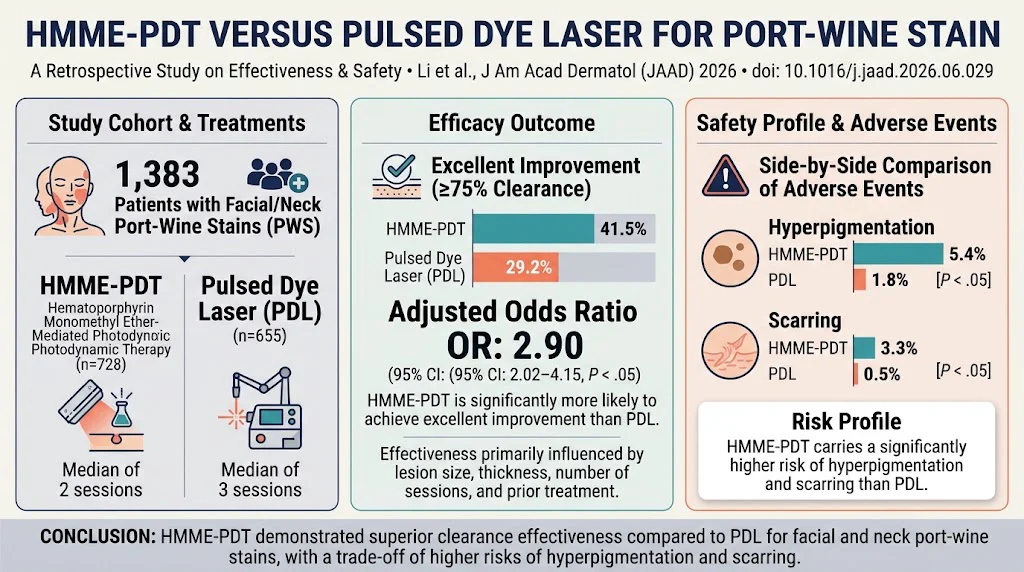
Hematoporphyrin monomethyl ether-mediated photodynamic therapy (HMME-PDT) demonstrates superior efficacy over pulsed dye laser (PDL) in treating facial and neck port-wine stains (PWS).
Patients receiving HMME-PDT achieved higher rates of excellent lesion clearance (≥75%) with fewer treatment sessions.
HMME-PDT poses a higher incidence of treatment-related hyperpigmentation and scarring than PDL, indicating a trade-off between effectiveness and safety.
Lesion size, thickness, number of treatment sessions, and prior treatment history significantly influence therapeutic outcomes.
Study Background
Port-wine stain (PWS) is a congenital vascular malformation characterized by ectatic capillaries primarily affecting the face and neck. It affects approximately 0.3% to 0.5% of newborns and can lead to psychosocial distress due to its conspicuous appearance. Pulsed dye laser (PDL) has been the first-line treatment modality for PWS for decades, capitalizing on selective photothermolysis targeting hemoglobin. However, limitations such as incomplete clearance and the need for multiple sessions prompt exploration of alternative treatments.
Hematoporphyrin monomethyl ether-mediated photodynamic therapy (HMME-PDT) is an emerging therapeutic option that combines photosensitization and targeted vascular injury through reactive oxygen species generation upon light activation. Early evidence indicates potential for superior lesion clearance in PWS, necessitating rigorous comparative evaluation against PDL.
Study Design
This retrospective study analyzed a large cohort comprising 728 patients treated with HMME-PDT and 655 patients treated with PDL for facial and neck PWS. The primary endpoint was the rate of excellent improvement, operationally defined as at least 75% lesion clearance. Effectiveness was assessed using logistic regression models adjusted for confounding variables including lesion size, thickness, number of treatment sessions, and prior treatments.
Treatment regimens varied; the median number of sessions was 2 for HMME-PDT and 3 for PDL groups respectively. Safety profiles were compared by recording incidences of adverse events such as hyperpigmentation and scarring. The study’s retrospective nature and absence of long-term follow-up represent key methodological considerations.
Key Findings
Unadjusted analyses demonstrated a higher proportion of patients achieving excellent lesion clearance in the HMME-PDT group (41.5%) compared to the PDL group (29.2%). After multivariate adjustment, HMME-PDT patients exhibited significantly greater odds of excellent improvement, with an odds ratio of 2.90 (95% CI: 2.02-4.15, P < .05).
The number of treatment sessions was fewer for HMME-PDT, indicating potential efficiency benefits. Notably, lesion size and thickness substantially affected outcomes, with larger and thicker lesions being less amenable to clearance. Prior treatments were also significant, potentially reflective of lesion chronicity or treatment resistance.
Regarding safety, the HMME-PDT group experienced a higher incidence of hyperpigmentation (5.4% vs. 1.8%) and scarring (3.3% vs. 0.5%) compared to the PDL cohort, both statistically significant (P < .05). These adverse effects necessitate careful patient selection and counseling.
Expert Commentary
The comparative effectiveness of HMME-PDT over PDL in this large registry is clinically significant, suggesting a valuable role for HMME-PDT in challenging PWS cases. The mechanistic advantage of HMME-PDT may lie in its dual action: selective vascular damage combined with photodynamic cytotoxicity, offering deeper or more comprehensive lesion targeting than PDL’s chromophore-specific thermolysis.
However, safety concerns including pigmentation changes and scarring should moderate enthusiasm and underscore the importance of individualized treatment planning. Prospective randomized trials with longer follow-up are essential to validate these findings, better delineate risk factors, and optimize protocols for minimizing complications.
Conclusion
This extensive retrospective comparison establishes HMME-PDT as a superior modality to PDL for achieving substantial lesion clearance in facial and neck port-wine stains, albeit with an increased risk of hyperpigmentation and scarring. Clinicians should weigh this benefit-risk profile while considering patient preferences and lesion characteristics. Future research should focus on refining HMME-PDT dosing parameters, identifying predictors of adverse outcomes, and conducting head-to-head randomized controlled trials to confirm long-term efficacy and safety.
Funding and ClinicalTrials.gov
The original study did not specify funding sources or clinical trial registration. Further prospective studies should adhere to transparent clinical trial registries and funding disclosures to enhance research rigor and trustworthiness.
References
Li X, Liu L, Diao P, Zhang L, Zhang T, Li Y, Han C, Chen H, Wei D, Yu H, Liu Q, Jiang X. Effectiveness and safety of hematoporphyrin monomethyl ether-mediated photodynamic therapy versus pulsed dye laser for port-wine stain: A retrospective study. J Am Acad Dermatol. 2026 Oct;95(4):1004-1010. doi: 10.1016/j.jaad.2026.06.029. Epub 2026 Jun 11. PMID: 42276513.