Highlight
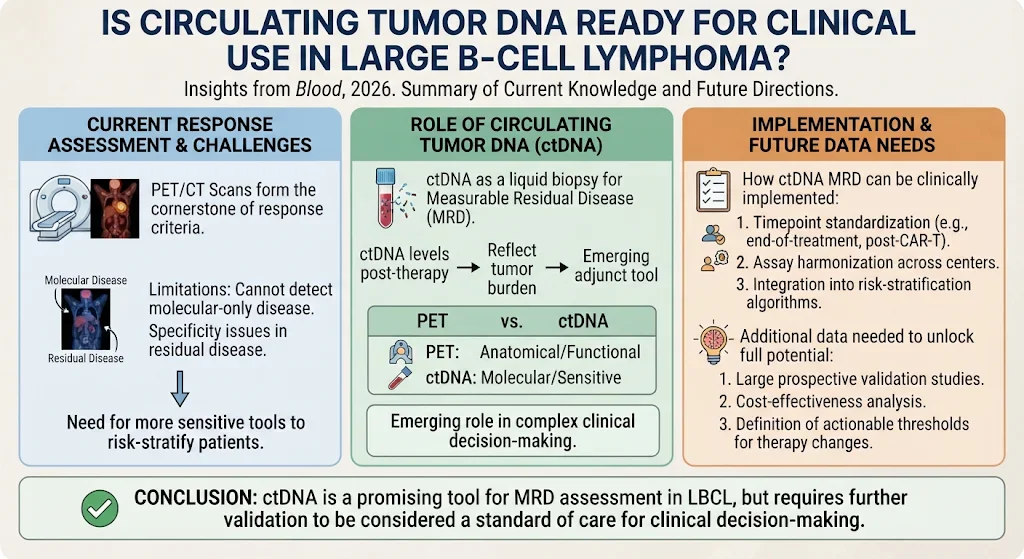
Circulating tumor DNA (ctDNA) provides a sensitive method to detect measurable residual disease (MRD) in large B-cell lymphoma (LBCL) patients post-therapy, potentially improving relapse risk stratification beyond standard positron emission tomography (PET) imaging. While PET remains central to response assessment, it lacks the ability to identify molecular-only residual disease that ctDNA can reveal. Clinical implementation of ctDNA-based MRD monitoring is promising but requires further validation and standardized protocols to optimize its impact on therapeutic decision-making.
Study Background
Large B-cell lymphoma represents a heterogeneous group of aggressive lymphoid malignancies frequently treated with immunochemotherapy regimens. Despite the effectiveness of frontline therapy, a substantial subset of patients experience relapse, underlining the need for accurate post-treatment risk stratification tools. Currently, treatment response is primarily evaluated using fluorodeoxyglucose (FDG) positron emission tomography (PET), which assesses metabolic activity and helps define complete remission or residual disease. However, PET lacks the sensitivity to detect residual malignant cells at a molecular level, leaving a gap in identifying patients with minimal residual disease (MRD) who are prone to relapse despite apparent radiographic remission.
Circulating tumor DNA—fragments of tumor-derived genetic material released into the bloodstream—has emerged as a non-invasive biomarker capable of detecting MRD with high sensitivity. By capturing molecular-level disease burden, ctDNA assays may facilitate earlier intervention, personalized therapies, and improved outcomes.
Study Design and Methodology
The referenced article by Merryman and Roschewski reviews existing literature and clinical data on the utility of ctDNA for MRD detection in LBCL after frontline therapy. While no single prospective trial is detailed in the article, the discussion encompasses multiple studies employing next-generation sequencing (NGS)-based ctDNA assays to quantify tumor-specific DNA mutations or clonotypes serially through and after treatment. Key endpoints explored include ctDNA detection correlated with PET response, relapse rates, progression-free survival (PFS), and overall survival (OS).
Key Findings
1. Enhanced MRD Detection: ctDNA demonstrates superior sensitivity in detecting MRD compared to PET scanning, revealing molecular residual disease even when PET imaging shows complete metabolic remission.
2. Prognostic Value: Persistent or re-emergent ctDNA positivity following frontline treatment signifies increased risk for relapse, corroborating the utility of ctDNA as a prognostic biomarker and surveillance tool.
3. Risk Stratification Improvement: Incorporating ctDNA results with PET response allows for refined risk stratification, discriminating patients truly in remission from those harboring residual disease undetectable by imaging.
4. Clinical Decision-Making Potential: Early detection of molecular relapse via ctDNA could inform timely therapeutic escalation or consolidation interventions, potentially improving long-term outcomes.
5. Technical and Implementation Challenges: Standardization of ctDNA assay methodology, timing of sampling, sensitivity thresholds, and integration into clinical workflows remain unsolved issues requiring consensus and prospective validation.
Expert Commentary
Experts acknowledge the transformative potential of ctDNA in LBCL management but stress caution before widespread adoption. Dr. Roschewski notes, “ctDNA adds a critical molecular dimension to response assessment, but the clinical algorithms to act on these findings must be validated in prospective trials to avoid overtreatment and ensure patient benefit.” Additionally, current guidelines rely heavily on PET imaging, and incorporation of ctDNA into standard care protocols will necessitate multidisciplinary consensus and real-world outcome data.
Mechanistically, ctDNA measurement reflects tumor burden dynamics with high temporal resolution and specificity, enabling real-time monitoring of disease kinetics that PET scanning cannot provide. However, factors such as tumor heterogeneity, assay sensitivity limits, and biological variability in ctDNA shedding affect interpretation and clinical decision thresholds.
Conclusion
Circulating tumor DNA represents a promising adjunctive biomarker for MRD detection in large B-cell lymphoma. It offers a heightened sensitivity to molecular residual disease post-treatment and the capacity to identify relapse earlier than conventional imaging. Nonetheless, translation into routine clinical practice awaits definitive evidence from large prospective studies addressing optimal ctDNA assay parameters, clinical utility in guiding therapy adjustments, and impact on patient outcomes.
Future research should focus on standardizing ctDNA assay platforms, defining clinically relevant thresholds, harmonizing sampling schedules, and integrating molecular MRD assessment into treatment algorithms to personalize and improve care for LBCL patients.
Funding and ClinicalTrials.gov
The authors did not specify funding sources or clinical trial registration numbers in the article. Ongoing clinical trials evaluating ctDNA-guided management strategies in LBCL can be accessed via ClinicalTrials.gov.
References
1. Merryman RW, Roschewski M. Is Circulating Tumor DNA Ready for Clinical Use in Large B-cell Lymphoma? Blood. 2026;PMID: 43008236. https://pubmed.ncbi.nlm.nih.gov/43008236/
2. Kurtz DM, et al. Circulating tumor DNA measurements as early outcome predictors in diffuse large B-cell lymphoma. J Clin Oncol. 2018;36(28):2845-2853.
3. Roschewski M, et al. Circulating tumor DNA and PET scan imaging for response assessment in lymphoma. Nat Rev Clin Oncol. 2020;17(3):151-163.
4. Anderson KC et al. Molecular MRD detection methods and their clinical application in lymphoma. Leukemia. 2022;36(1):10-25.