Highlight
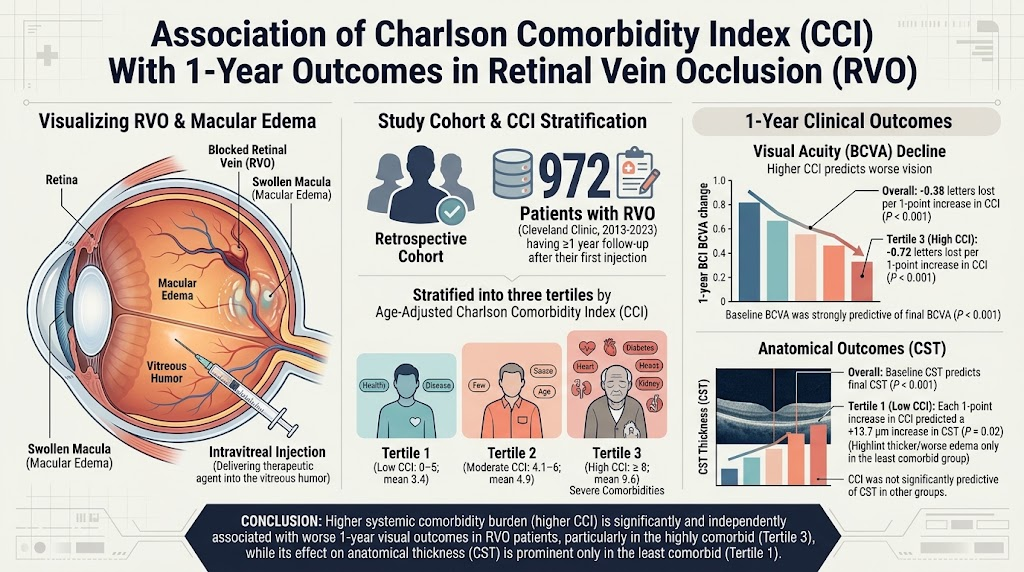
This study demonstrates the significant association between the Charlson Comorbidity Index (CCI) and 1-year visual outcomes in patients with macular edema secondary to retinal vein occlusion (RVO). Higher CCI scores predicted poorer visual acuity outcomes, especially in patients with a high comorbidity burden. Baseline visual acuity remained a strong predictor of final visual results across all comorbidity levels. Notably, CCI’s impact on central subfield thickness (CST) was significant only in patients with lower comorbidity scores.
Study Background
Retinal vein occlusion (RVO) is among the most common vascular disorders of the retina leading to vision impairment, predominantly due to secondary macular edema. Macular edema, the accumulation of fluid in the central retina, compromises visual acuity and quality of life. Treatment often involves intravitreal injections targeting vascular endothelial growth factor (VEGF) or steroids to reduce edema and improve vision.
Comorbid systemic diseases—such as cardiovascular disease, diabetes, and chronic kidney disease—are well recognized to influence ocular vascular health and treatment response. The Charlson Comorbidity Index (CCI) is a validated tool used to quantify the burden of comorbidities and predict mortality risk in various clinical settings. However, its role as a prognostic indicator for visual and anatomical outcomes in RVO-related macular edema has not been extensively elucidated.
Study Design
This retrospective clinical cohort study included patients diagnosed with RVO at the Cole Eye Institute of Cleveland Clinic between 2013 and 2023. Participants met the inclusion criteria of being older than 18 years with confirmed RVO diagnosis according to ICD-9 and ICD-10 codes, availability of complete CCI scores, and at least one year of follow-up after their initial intravitreal injection. Eyes that had undergone ocular surgery, trauma, or panretinal photocoagulation were excluded to eliminate confounding factors.
The study calculated age-adjusted CCI scores from detailed chart reviews. In cases of bilateral RVO, one eye was randomly selected to avoid data duplication. Patients were stratified into tertiles based on CCI distribution: tertile 1 (CCI 0–5), tertile 2 (CCI 4.1–6), and tertile 3 (CCI ≥8). The primary endpoints were best-corrected visual acuity (BCVA) and central subfield thickness (CST) measured at one year post-baseline. Multivariable linear regression models assessed the predictive value of CCI and other clinical covariates on these outcomes.
Key Findings
The cohort comprised 972 patients with an average CCI score of 6.2, indicating a substantial burden of systemic comorbidity. Analysis demonstrated that each one-point increase in CCI was associated with a 0.38-letter decrease in 1-year BCVA (p<0.001), indicating that more comorbid patients had worse visual outcomes after macular edema treatment.
Baseline BCVA robustly predicted follow-up BCVA across all tertiles (p<0.001), underscoring the importance of initial visual status. The effect of CCI on vision was more pronounced in the highest comorbidity tertile, where each additional CCI point correlated with a 0.72-letter reduction in BCVA (p<0.001), highlighting that systemic burden has a greater influence among patients with multiple health issues.
Regarding anatomical outcomes, baseline CST strongly predicted 1-year CST in all patients (p<0.001). However, CCI was only significantly associated with CST changes in the lowest comorbidity tertile, where each CCI point predicted a 13.7 µm increase in CST (p=0.02). This suggests the interplay between systemic disease burden and macular thickness is complex and may be more relevant in patients with fewer comorbidities.
Subgroup interaction analyses revealed no significant differences in the association of CCI with outcomes between RVO subtypes, specifically central retinal vein occlusion (CRVO) versus branch RVO (p=0.269 for BCVA, p=0.695 for CST).
Expert Commentary
This comprehensive study adds valuable evidence connecting systemic health quantified by the CCI to ocular outcomes in RVO-induced macular edema. The findings align with the growing understanding that systemic comorbidities impact retinal vascular disease progression and treatment success. The stronger predictive value of CCI in patients with higher comorbidity burden underscores the need for integrated care approaches addressing systemic disease control alongside ophthalmic treatment.
However, the retrospective design warrants cautious interpretation due to possible residual confounding and selection bias despite rigorous exclusion criteria. Also, the relatively modest effect size on BCVA letters per CCI point suggests that while comorbidities are influential, other factors such as treatment adherence, timely intervention, and ocular characteristics also determine outcomes.
Future prospective studies could investigate mechanistic pathways through which systemic illness exacerbates retinal vascular pathology. Moreover, integrating comorbidity indices like CCI might refine personalized prognostication and aid clinicians in counseling patients about expected outcomes.
Conclusion
The Charlson Comorbidity Index is a significant independent predictor of 1-year visual acuity outcomes in patients with macular edema secondary to retinal vein occlusion. Patients with higher comorbidity burdens experience poorer visual recovery despite standardized treatment. Although the association with anatomical thickness was less consistent, the data highlight the relevance of systemic health in retinal disease prognosis. These insights emphasize the importance of comprehensive systemic evaluation and management in patients undergoing treatment for RVO-related macular edema.
Funding and ClinicalTrials.gov
The study was conducted at the Cole Eye Institute, Cleveland Clinic, with no specific funding disclosures reported. There is no mention of clinical trial registration.
References
1. Xavier JJ, Reed HA, Bahierathan KS, Kim SB, Talcott KE, Singh RP. Association of the Charlson Comorbidity Index With 1-Year Outcomes in Patients With Macular Edema Secondary to Retinal Vein Occlusion. Am J Ophthalmol. 2026 Jun 19;290:161-168. PMID: 42320617.
2. Rogers S, McIntosh RL, Cheung N, et al. The prevalence of retinal vein occlusion: pooled data from population studies from the United States, Europe, Asia, and Australia. Ophthalmology. 2010 Feb;117(2):313-319.e1.
3. Charlson ME, Pompei P, Ales KL, MacKenzie CR. A new method of classifying prognostic comorbidity in longitudinal studies: development and validation. J Chronic Dis. 1987;40(5):373-383.
4. Campochiaro PA. Ocular neovascularization. J Mol Med (Berl). 2013 Apr;91(3):311-321.