We use cookies

Our website uses essential cookies and, with your consent, additional cookies to measure performance and improve our services. Cookie Policy.

You can change your choice at any time.

MMedXYNews
HomeVideos
MedXY AI/MedXY News/Section: Clinical Updates

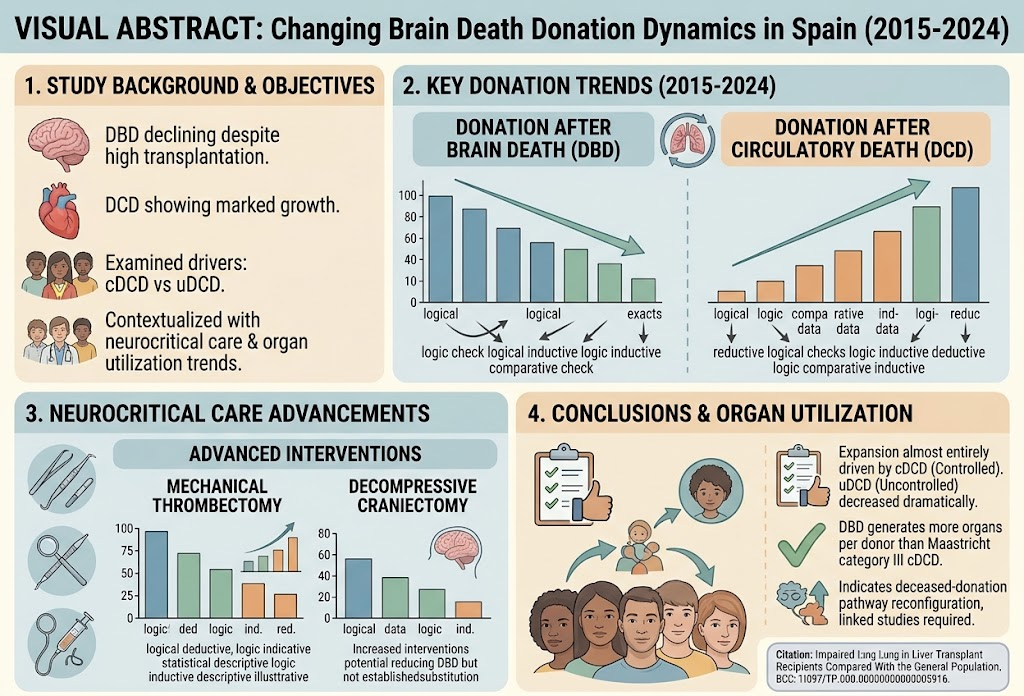
Changing Brain Death Donation Dynamics in Spain: A National Overview of Neurocritical Care and Organ Donation Trends
MedXY Editorial Team•Oct 2, 2026•Clinical Updates
brain deathcirculatory deathneurocritical careorgan donationSpain

Highlights

  • Declining brain death donation (DBD) in Spain contrasts with a robust rise in controlled donation after circulatory death (cDCD) from 2015 to 2024.
  • Uncontrolled donation after circulatory death (uDCD) has markedly declined, making cDCD the predominant DCD form (98.3% in 2024).
  • Neurocritical care interventions such as mechanical thrombectomy and decompressive craniectomy increased, potentially influencing donation potential and pathways.
  • DBD donors remain more efficient in organ recovery and transplantation yield compared to Maastricht category III cDCD donors.

Background

MedXY registered readers

Sign in free to continue reading

Create or use your MedXY account to unlock the complete article.

This article was created using several editorial tools, including AI, as part of the process. Human editors reviewed this content before publication.

Related articles

Open language-specific specialty feeds and department pages.

Exploring ICU Staff Perspectives on Brain Death: Insights from a Swiss Multicenter SurveyA Swiss study reveals ICU professionals’ perceptions, knowledge, and ethical views on brain death, highlighting knowledge gaps and the positive impact of clinical experience on understanding.Oct 1, 2026When Does an ICP Crisis Really Count? BOOST II Raises Questions About Bedside Detection in Severe TBIA post hoc BOOST II analysis found that many bedside-labeled intracranial pressure crises were not confirmed by continuous electronic data, challenging current ICP episode definitions in severe traumatic brain injury.Jun 19, 2026Timing Extubation After Thrombectomy: Evidence from the EDESTROKE Trial and Advanced Post-Reperfusion ManagementThe EDESTROKE trial finds no significant difference in 90-day functional outcomes between early (<6h) and delayed (6-12h) extubation post-thrombectomy, shifting focus toward microvascular and hemodynamic optimization.Apr 5, 2026Perihematomal Edema Dynamics and Functional Outcomes in Spontaneous Intracerebral Hemorrhage: Insights from a Global IPD Meta-Analysis
Loading comments...
MedXY briefing

Get the free newsletter

Evidence-led clinical news, trends, and analysis—delivered to your inbox.

Ask MedXY AI

Most popular

Intimate Health
Five Benefits for Women Continuing Sexual Activity After Menopause
Intimate Health
Why Some Women Have a Strong Sex Drive—And Why Men Shouldn't Worry About It
Nursing & care
How often should a couple have sex?
Cardiology
Precision Medicine for Long QT Syndrome Type 2: Lumacaftor Corrects Trafficking Defects and Shortens QT Interval
General Surgery
Optimizing Postoperative Opioid Prescriptions After Intra-Abdominal Cancer Surgery: Comparing the 5x-Multiplier and 3-Tier Models
© 2026 MedXY
Contact usAbout usPrivacy PolicyMedXY story
This article synthesizes evidence from a large-scale individual participant data meta-analysis, demonstrating that early perihematomal edema growth (at 24 and 72 hours) is an independent predictor of death and disability after intracerebral
Mar 10, 2026
Plasma GFAP and NfL as Real-Time Predictors of Brain Injury and Long-Term Disability in Pediatric ECMOA prospective study demonstrates that rising levels of plasma GFAP and NfL precede neuroimaging-confirmed brain injury in children on ECMO. These biomarkers are also strongly associated with mortality and long-term functional impairment, ofMar 2, 2026
Recombinant Factor VIIa Fails to Improve Functional Outcomes in Hyperacute Intracerebral Haemorrhage Despite Reduced Bleeding: Results from the FASTEST TrialThe FASTEST trial demonstrated that while recombinant factor VIIa administered within two hours of intracerebral haemorrhage onset significantly reduced hematoma growth, it failed to improve functional outcomes at 180 days and increased theFeb 17, 2026