Beyond Vision Loss: Psychosocial Factors Influencing Psychological Distress in Primary Open-Angle Glaucoma
Highlight
- Psychological distress affects nearly one-fifth of patients with primary open-angle glaucoma (POAG).
- Psychosocial variables—especially self-efficacy and social support—are strong independent predictors of distress beyond clinical indicators.
- Interactions between vision-related quality of life, social support, and self-efficacy influence the risk of psychological distress, suggesting multifaceted psychosocial dynamics.
- Integrating psychosocial assessments and interventions into glaucoma care may improve emotional well-being and potentially clinical outcomes.
Study Background
Primary open-angle glaucoma (POAG) is a chronic, progressive optic neuropathy characterized by gradual visual field loss, potentially leading to irreversible blindness. It afflicts millions worldwide, with increasing prevalence in aging populations. While clinical management focuses on intraocular pressure control and preservation of visual function, the disease’s impact extends beyond vision, affecting patients’ psychological health. Psychological distress—encompassing anxiety and depression—can influence patients’ quality of life (QoL), adherence to treatment, and overall prognosis. Yet, the determinants of distress in glaucoma remain incompletely understood, particularly how psychosocial factors interplay with clinical metrics to shape emotional outcomes. This gap limits comprehensive patient-centered care in glaucoma clinics. The study by Vaidyanathan et al. aims to elucidate psychosocial and clinical predictors of psychological distress in patients with POAG, highlighting opportunities for integrated models addressing modifiable psychosocial vulnerabilities.
Study Design
This prospective cross-sectional study recruited 300 POAG patients from the Duke Eye Center glaucoma clinics between September 2022 and August 2023. Inclusion criteria involved a confirmed diagnosis of POAG with documented visual field data. Participants completed validated self-report instruments including:
- Hospital Anxiety and Depression Scale (HADS) to measure psychological distress.
- Self-Efficacy for Managing Chronic Disease Scale (SE-6) assessing confidence in disease self-management.
- Modified Medical Outcomes Study Social Support Survey Scale (MOS-8) measuring perceived social support.
- National Eye Institute Visual Function Questionnaire (NEI VFQ-9) assessing vision-related QoL.
Clinical data were abstracted from electronic health records, incorporating demographics, socioeconomic status, and glaucoma severity metrics. Statistical analyses employed univariable and multivariable Poisson regression models to estimate associations of psychosocial and clinical variables with psychological distress (HADS total score). Interaction effects among psychosocial factors were also explored. Risk ratios (RRs) and p-values were reported, with significance set at p < 0.05.
Key Findings
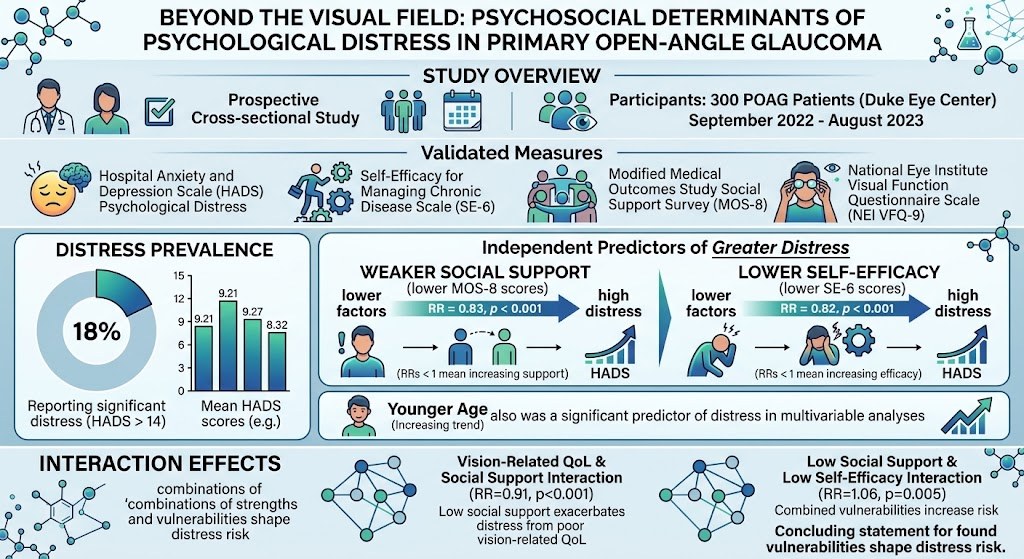
The cohort had a mean age of 68.4 years, was 52% female, 81% White, and 15% Black/African American. Mean total HADS score was 9.21 (SD 6.28), with 18% (n=55) exceeding the threshold for significant distress (HADS >14).
- Demographic and Socioeconomic Correlates: Younger age, female sex, and lower socioeconomic status (education, income, employment) predicted higher distress in univariable models. However, only younger age retained statistical significance in adjusted analyses.
- Clinical Markers: While certain clinical indicators correlated with distress univariably, these lost significance after controlling for psychosocial factors.
- Psychosocial Factors: Poorer vision-related QoL was strongly associated with increased distress (RR=0.78, p<0.001). Lower social support (RR=0.78, p<0.001) and weaker self-efficacy (RR=0.74, p<0.001) similarly predicted heightened distress.
- Multivariable Analysis: After adjustment, both self-efficacy (RR=0.82, p<0.001) and social support (RR=0.83, p<0.001) remained independently linked to psychological distress, whereas vision-related QoL did not, indicating mediation or shared variance.
- Interaction Effects: Significant interactions suggested synergistic influences on distress risk. Notably, social support modified the association between vision-related QoL and distress (RR=0.91, p<0.001). Similarly, combined low social support and low self-efficacy increased distress risk beyond individual effects (RR=1.06, p=0.005).
These findings highlight that psychosocial strengths—such as robust social networks and confidence in disease management—may buffer the negative emotional impact of glaucoma beyond measurable visual impairment.
Expert Commentary
The study by Vaidyanathan et al. aligns with an emerging paradigm emphasizing the biopsychosocial model in chronic ophthalmologic diseases. Psychological distress in glaucoma, traditionally linked closely with visual field loss severity, is now recognized as multifactorial. Importantly, self-efficacy reflects patients’ active engagement and confidence in managing their disease, a dimension potentially amenable to intervention through education and supportive care strategies. Similarly, social support mitigates distress by providing emotional resources and practical assistance.
This research underscores the inadequacy of relying solely on traditional clinical parameters to assess patient well-being. By quantifying psychosocial determinants and defining their interactive effects, this study advances the precision of risk stratification for psychological distress.
Study limitations include single-center recruitment, potentially limiting generalizability, and the cross-sectional design, which restricts causal inference. Longitudinal studies would clarify the temporal dynamics between psychosocial factors and distress. Additionally, diversity in racial and socioeconomic representation warrants expansion given known disparities in glaucoma outcomes.
Conclusion
Psychological distress in POAG patients is significantly influenced by modifiable psychosocial factors such as self-efficacy and social support, beyond the degree of visual impairment measured clinically. These interrelated determinants suggest that integrated glaucoma care should incorporate psychosocial screening and tailored interventions to enhance emotional well-being. Addressing these factors may improve adherence, QoL, and potentially clinical glaucoma outcomes. Future research should explore longitudinal impacts and intervention efficacy within diverse patient populations.
Funding and ClinicalTrials.gov
No specific funding sources or clinical trial registration information was provided in the referenced study.
References
1. Vaidyanathan A, Baek Y, Ekeh L, et al. Beyond the Visual Field: Psychosocial Determinants of Psychological Distress in Primary Open-Angle Glaucoma. American journal of ophthalmology. 2026 Aug 10. PMID: 42575406.
2. Zhang X, Zou H, Yan J, et al. Impact of psychological distress on quality of life among glaucoma patients: A meta-analysis. J Glaucoma. 2021;30(12):1161-1167.
3. Chou CF, Sherrod CE, Zhang X, et al. Psychosocial support and treatment adherence in glaucoma: A systematic review. BMC Ophthalmol. 2019;19(1):45.
4. Bandura A. Self-efficacy mechanism in human agency. American Psychologist. 1982;37(2):122–147.
5. Yochim BP, Mueller AE, Lengerich EJ. Social support and stress in glaucoma patients: A review of literature. Optom Vis Sci. 2022;99(6):387-394.
This article was created using several editorial tools, including AI, as part of the process. Human editors reviewed this content before publication.