Highlight
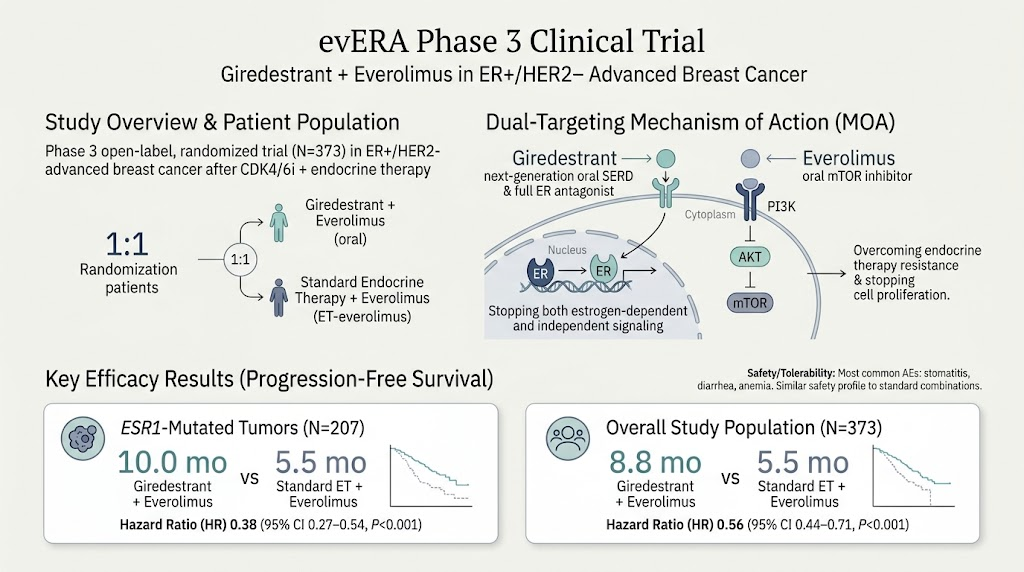
The phase 3 evERA trial demonstrated that an all-oral regimen of giredestrant combined with everolimus significantly prolongs progression-free survival (PFS) compared to standard endocrine therapies plus everolimus in patients with ER-positive, HER2-negative advanced breast cancer who progressed on prior CDK4/6 inhibitors. This benefit was most pronounced in tumors harboring ESR1 mutations. The safety profiles of both regimens were comparable, with stomatitis, diarrhea, and anemia being the most common adverse events.
Study Background
Estrogen receptor (ER)-positive, human epidermal growth factor receptor 2 (HER2)-negative breast cancer represents a large subset of advanced breast cancers. Endocrine therapy remains the cornerstone of treatment; however, acquired resistance is common, particularly in the context of prior cyclin-dependent kinase 4 and 6 (CDK4/6) inhibitor therapy. Mutations in the ESR1 gene, encoding the estrogen receptor, contribute to endocrine resistance by constitutively activating ER signaling. Additionally, activation of the phosphatidylinositol 3-kinase (PI3K)-AKT-mammalian target of rapamycin (mTOR) pathway also drives resistance mechanisms.
Everolimus, an mTOR inhibitor, has been previously approved to overcome endocrine resistance by targeting the PI3K-AKT-mTOR pathway. Giredestrant is a novel selective estrogen receptor degrader (SERD) aimed at overcoming ESR1 mutations and blocking ER signaling more effectively than conventional endocrine agents. Combining giredestrant with everolimus might synergistically inhibit both ER and mTOR pathways to improve treatment outcomes in this resistant population.
Study Design
This phase 3, open-label, randomized clinical trial enrolled patients with ER-positive, HER2-negative locally advanced or metastatic breast cancer who exhibited disease progression after treatment with a CDK4/6 inhibitor plus endocrine therapy. Eligible patients were randomized in a 1:1 ratio to receive either giredestrant plus everolimus or a standard endocrine therapy (exemestane, fulvestrant, or tamoxifen) plus everolimus. Both regimens were administered orally.
The primary endpoint was investigator-assessed progression-free survival (PFS), assessed first in the subset of patients with ESR1-mutated tumors and subsequently in the overall trial population. Safety and tolerability were secondary endpoints.
Key Findings
A total of 373 patients were randomized: 183 in the giredestrant-everolimus arm and 190 in the standard endocrine therapy-everolimus arm. Among 207 patients with ESR1-mutant tumors, median PFS was significantly longer with giredestrant-everolimus at 10.0 months versus 5.5 months with standard endocrine therapy-everolimus (hazard ratio [HR] for progression or death, 0.38; 95% confidence interval [CI], 0.27 to 0.54; P<0.001).
In the overall study population, the median PFS was 8.8 months for the giredestrant-everolimus group and 5.5 months for the standard therapy-everolimus group (HR, 0.56; 95% CI, 0.44 to 0.71; P<0.001). This demonstrates a clinically meaningful and statistically significant improvement favoring the combination of giredestrant with everolimus.
The safety profile was similar between groups. Adverse events of any grade occurred in 98.9% of patients receiving giredestrant-everolimus and 96.8% receiving standard therapy-everolimus. The most common adverse events were stomatitis (47.3% vs. 48.9%), diarrhea (26.9% vs. 22.6%), and anemia (23.6% vs. 21.0%). These side effects are consistent with known class effects of mTOR inhibitors and SERDs.
Expert Commentary
This trial provides robust evidence supporting the combination of giredestrant plus everolimus to overcome endocrine resistance in patients with advanced ER-positive, HER2-negative breast cancer, especially in the presence of ESR1 mutations. The marked improvement in PFS highlights the benefit of dual blockade of ER and mTOR pathways, addressing key molecular mechanisms driving resistance after CDK4/6 inhibitor treatment.
The all-oral administration of both agents enhances patient convenience and adherence compared to regimens requiring intramuscular injections or intravenous administration. Prior studies have demonstrated limited efficacy of standard endocrine therapies combined with everolimus in similar populations, underscoring the superiority of this novel approach.
Study limitations include the open-label design and reliance on investigator-assessed PFS without central independent radiologic review, which may introduce some bias. Further follow-up and overall survival data are needed to confirm long-term benefits. Additionally, the incidence and management of stomatitis remain important considerations to optimize patient quality of life.
Biologically, the effectiveness in ESR1-mutated tumors aligns with giredestrant’s superior ER-degrading activity, directly targeting ligand-independent ER signaling mutations that confer resistance.
Conclusion
The evERA phase 3 trial establishes giredestrant plus everolimus as a new effective treatment option for patients with ER-positive, HER2-negative advanced breast cancer after progression on CDK4/6 inhibitor therapy. The combination significantly prolongs progression-free survival, particularly in patients harboring ESR1 mutations, with a manageable safety profile comparable to standard endocrine therapy plus everolimus.
This regimen’s all-oral administration and mechanism-based synergy open promising avenues to overcome endocrine resistance, addressing a critical unmet need in advanced breast cancer management. Incorporation into clinical practice guidelines will likely improve outcomes for this challenging patient population. Future investigations should evaluate overall survival benefits, quality of life, and optimal sequencing with other therapies.
Funding and Clinical Trial Registration
This study was funded by Genentech. The clinical trial is registered under ClinicalTrials.gov number NCT05306340.
References
Mayer EL, Tolaney SM, Martín M, Vidal GA, Moscetti L, Jhaveri KL, Brufsky A, Gradishar WJ, Schneeweiss A, Niikura N, Favret A, Alfie M, Lee KS, Khan S, Feldman MB, Day BM, Lam LH, Darbonne WC, Shah MD, Griffiths KL, DiLallo G, Pérez-Moreno PD, Rugo HS; evERA Breast Cancer Investigators. Giredestrant plus Everolimus in Advanced Breast Cancer. N Engl J Med. 2026 Oct 1;395(13):1285-1298. doi: 10.1056/NEJMoa2602457. PMID: 42814929; PMCID: PMC13674676.