Advancing Familial Hypercholesterolemia Diagnosis: Activity-Normalized Prime Editing for Comprehensive LDLR Variant Classification
Highlight
1. Development of an activity-normalized prime editing screening pipeline enables accurate functional assessment of 5184 LDLR coding variants affecting LDL cholesterol uptake.
2. The method corrects for variable editing efficiency using a paired genotypic outcome reporter, improving precision compared to existing pooled genome editing techniques.
3. Functional classification correlates well with clinical data from ClinVar and UK Biobank, allowing reclassification of many variants of uncertain significance (VUS).
4. Discovery of gain-of-function LDLR variants and unique detection of splice-altering variants highlight new biological insights with potential therapeutic implications.
Study Background
Familial hypercholesterolemia (FH) is a common inherited lipid disorder primarily caused by pathogenic variants in the LDL receptor (LDLR) gene. LDLR is essential for clearing low-density lipoprotein cholesterol (LDL-C) from circulation, and variants compromising its function lead to elevated LDL-C and increased premature coronary artery disease risk. Clinical guidelines emphasize early genetic diagnosis for timely lipid-lowering treatment and cascade screening of family members to prevent adverse cardiovascular events.
Despite advances in sequencing, the majority of LDLR coding variants detected in patient populations remain classified as variants of uncertain significance due to lack of robust functional evidence. This uncertainty hampers clinical decision-making and limits the effectiveness of precision medicine approaches. Traditional variant interpretation relies heavily on computational predictions and population frequency data, which lack direct functional assessment. Therefore, there is a critical unmet need for scalable, high-throughput functional assays that can accurately classify LDLR variants to support clinical diagnostics and individualized therapy.
Study Design
The study introduces an innovative high-throughput prime editing screening pipeline designed to measure the functional impact of 5184 LDLR coding variants on LDL-C uptake. Prime editing, a novel CRISPR-derived genome editing technology, enables precise and endogenous installation of single-nucleotide variants without double-strand breaks.
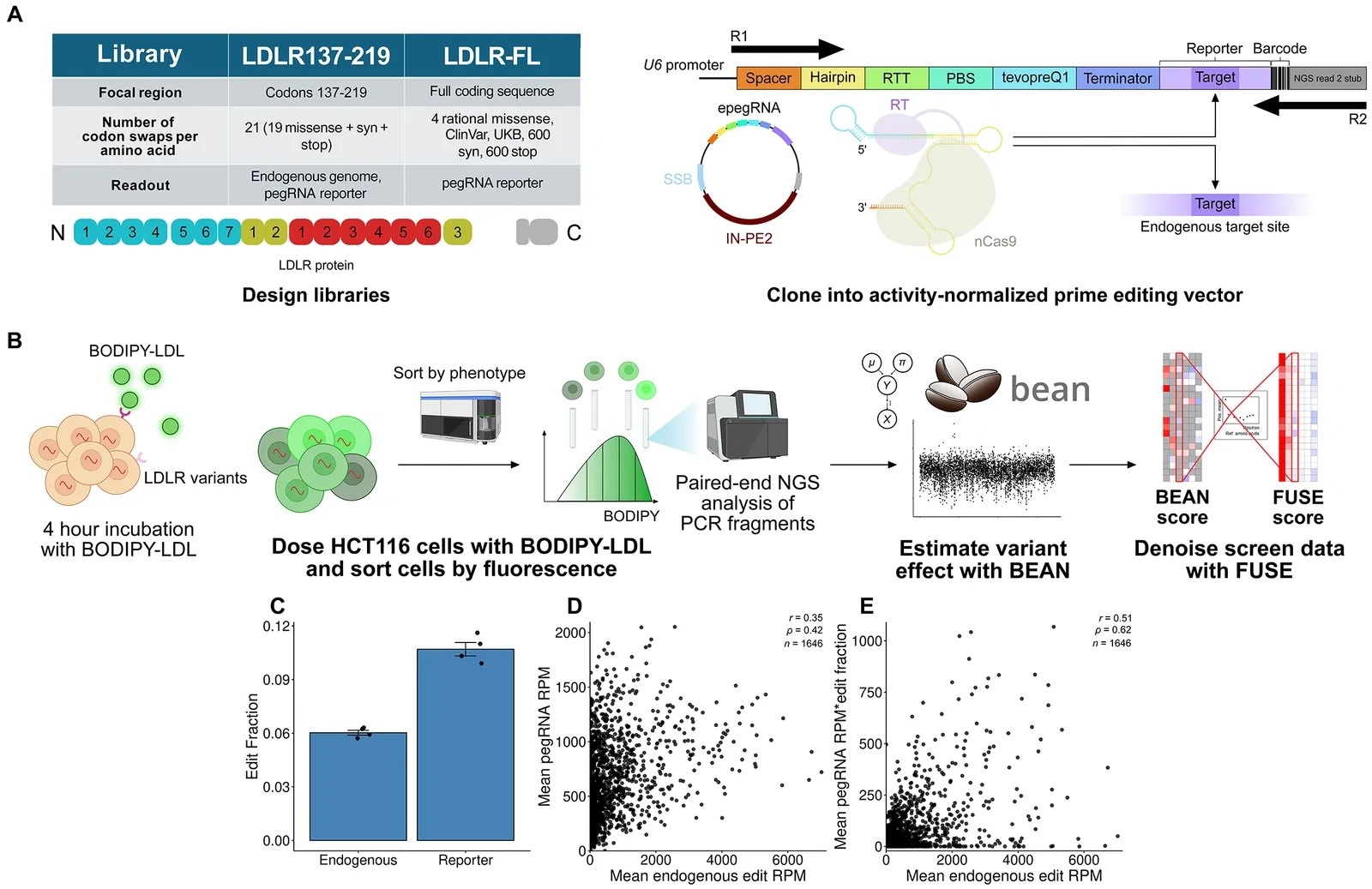
Key features of the design include pairing each prime editing guide RNA with a genotypic outcome reporter that quantifies editing efficiency. This paired reporter system allows normalization for variability in editing efficiency across different guides, overcoming a major limitation of prior pooled genome editing screens that confound functional effect estimates.
The variants evaluated encompassed missense substitutions distributed across the LDLR coding region. A statistical framework was applied to jointly analyze all missense variants at each amino acid position, refining variant effect estimates by leveraging positional context.
Key Findings
Validation of Activity Normalization: Correlation between prime editing frequencies of the reporter construct and endogenous variants demonstrated that the activity normalization approach effectively corrects for differential editing efficiencies, providing confidence in the functional screening results.
Comprehensive Functional Spectrum: Variant functional scores exhibited a continuous distribution reflecting a range of impacts on LDL-C uptake, distinguishing between loss-of-function and likely benign variants. The method robustly separated known pathogenic and benign variants annotated in ClinVar.
Clinical Correlation: Functional scores correlated with LDL-C levels measured in UK Biobank participants, substantiating the physiological relevance of the screening results. This correlation supports the validity of functionally derived variant classifications in predicting clinical phenotypes.
Reclassification Potential: Integrating functional data with computational predictions, population allele frequencies, and clinical context enabled reclassification of 322 out of 434 variants previously categorized as VUS, conflicting, or absent in ClinVar. These variants now meet evidence thresholds per ACMG/AMP guidelines for more definitive classification, significantly expanding the actionable diagnostic landscape for FH.
Discovery of Gain-of-Function Variants: A notable cluster of gain-of-function variants was identified in the LDLR class A repeat 5 domain, some enhancing LDL-C uptake through increased interaction with apolipoprotein B. This finding reveals biological mechanisms underlying LDLR function and offers promising therapeutic targets for genome editing-based interventions.
Unique Splice Variant Detection: By installing variants endogenously at the DNA level, prime editing uniquely identified splice-altering coding variants overlooked by cDNA-based functional assays and computational pathogenicity predictors. This highlights an important advantage of endogenous editing models over traditional methods, improving detection of clinically relevant variants.
Expert Commentary
This innovative study represents a significant advance in functional genomics applied to cardiovascular genetics. The activity-normalized prime editing system overcomes prior technical shortcomings related to editing variability, offering a scalable solution for comprehensive variant effect screening. By enhancing biological insight into LDLR variant pathogenicity and enabling reclassification of numerous clinically ambiguous variants, the platform promises direct translational impact for FH diagnosis and treatment.
From a molecular cardiology perspective, the identification of gain-of-function LDLR variants challenges the traditional loss-of-function paradigm and suggests that modulating receptor activity could provide a novel therapeutic avenue. Additionally, the ability to detect splice-altering variants at scale addresses a critical gap in genetic diagnostics where such variants are often missed, further improving clinical risk stratification.
Limitations include the focus on coding variants without comprehensive assessment of noncoding regulatory elements and the inherent constraints of in vitro LDL-C uptake assays to fully recapitulate in vivo physiology. Further validation in patient-derived models and clinical correlation studies will be essential to confirm and extend these findings.
Conclusion
The study presents a robust, high-throughput prime editing screening framework for LDLR variant classification that significantly advances genetic diagnosis in familial hypercholesterolemia. By providing standardized functional evidence aligned with ACMG/AMP guidelines, this approach facilitates more accurate classification of variants, supporting earlier intervention and personalized management in FH patients and families.
The discovery of gain-of-function alleles and splice-altering variants underscores the utility of endogenous genome editing models for uncovering novel mechanistic insights with therapeutic relevance. Overall, this work exemplifies the integration of cutting-edge genome editing technology with clinical genomics to address longstanding challenges in cardiovascular precision medicine.
Funding and Clinical Trials
The study was supported by institutional research grants and may have involved clinical cohorts such as UK Biobank for phenotype correlation. No specific clinical trial registration was noted.
References
1. Zhou PJ, Velimirovic M, Yu T, et al. LDLR Variant Classification Through Activity-Normalized Prime Editing Screening. Circulation. 2026; (PMID: 42677454).
2. Richards S, Aziz N, Bale S, et al. Standards and guidelines for the interpretation of sequence variants: a joint consensus recommendation of the American College of Medical Genetics and Genomics and the Association for Molecular Pathology. Genet Med. 2015;17(5):405-424.
3. Abifadel M, Varret M, Rabès JP, et al. Mutations in PCSK9 cause autosomal dominant hypercholesterolemia. Nat Genet. 2003;34(2):154-156.
4. Khera AV, Won HH, Peloso GM, et al. Diagnostic Yield and Clinical Utility of Sequencing Familial Hypercholesterolemia Genes in Patients With Severe Hypercholesterolemia. J Am Coll Cardiol. 2016;67(22):2578-2589.
This article was created using several editorial tools, including AI, as part of the process. Human editors reviewed this content before publication.