MMedXYNews
HomeVideos
MedXY AI/MedXY News/Section: Critical Care

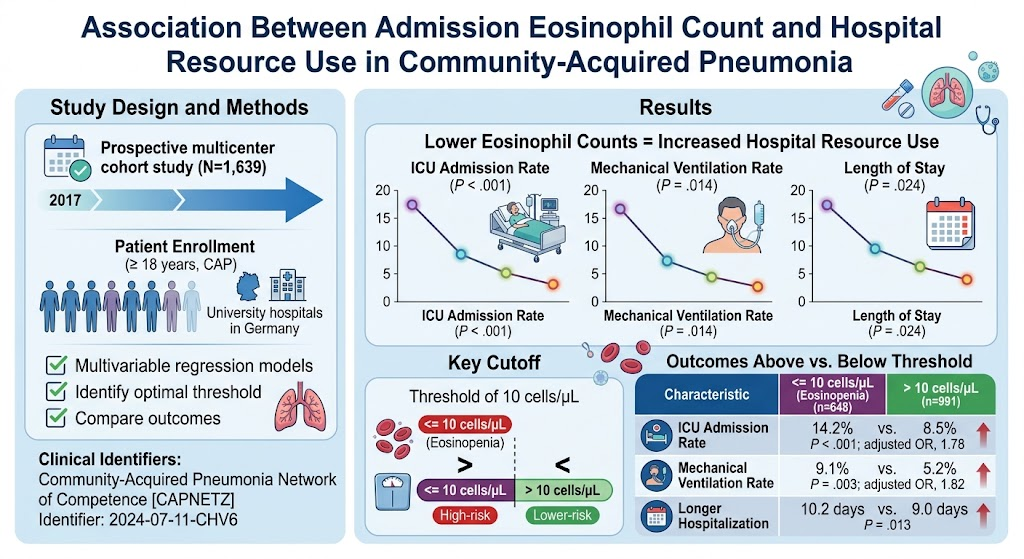
Admission Eosinopenia Predicts Increased Hospital Resource Use in Community-Acquired Pneumonia: Insights from a Prospective Multicenter Study
MedXY Editorial Team•Aug 24, 2026•Critical Care
社区获得性肺炎,合并医疗复杂性患儿,抗菌药物管理,窄谱抗生素EosinopeniaICU admissionHospital Resource Use

Highlight

  • Lower admission eosinophil counts correlate with increased ICU admissions and mechanical ventilation in community-acquired pneumonia (CAP) patients.
  • An eosinophil count threshold of ≤10 cells/μL effectively stratifies patients at higher risk for greater hospital resource use.
  • Eosinopenia at admission also associates with longer hospital length of stay, independent of systemic glucocorticoid treatment.
  • Admission eosinophil count may serve as an accessible biomarker to guide healthcare resource allocation in CAP management.

Study Background

MedXY registered readers

Sign in free to continue reading

Create or use your MedXY account to unlock the complete article.

This article was created using several editorial tools, including AI, as part of the process. Human editors reviewed this content before publication.

Related articles

Open language-specific specialty feeds and department pages.

Optimizing Antibiotic Therapy for Community-Acquired Pneumonia in Children with Medical Complexity: Evidence for Narrow-Spectrum UseIn children with medical complexity hospitalized for nonsevere community-acquired pneumonia, broad-spectrum antibiotics show no advantage over narrow-spectrum agents, supporting targeted aminopenicillin use to improve outcomes and antibiotiOct 17, 2026Evolving Predictors of Severe COVID-19 Compared to Seasonal Influenza: Insights from a Nationwide Swedish CohortThis nationwide Swedish study tracks shifting predictors of critical illness during different COVID-19 pandemic periods and compares them to seasonal influenza, highlighting vaccination status and age as key risk factors for severe outcomesSep 24, 2026SwissLEGIO Score: A Simplified Tool to Streamline Legionella Testing in Community-Acquired PneumoniaThe SwissLEGIO score refines Legionella prediction in community-acquired pneumonia, enhancing specificity while maintaining high sensitivity, thereby optimizing microbiological testing and improving clinical management.Aug 7, 2026
Loading comments...
MedXY briefing

Get the free newsletter

Evidence-led clinical news, trends, and analysis—delivered to your inbox.

Ask MedXY AI

Most popular

Intimate Health
Five Benefits for Women Continuing Sexual Activity After Menopause
Intimate Health
Why Some Women Have a Strong Sex Drive—And Why Men Shouldn't Worry About It
Nursing & care
How often should a couple have sex?
Cardiology
Precision Medicine for Long QT Syndrome Type 2: Lumacaftor Corrects Trafficking Defects and Shortens QT Interval
General Surgery
Optimizing Postoperative Opioid Prescriptions After Intra-Abdominal Cancer Surgery: Comparing the 5x-Multiplier and 3-Tier Models
© 2026 MedXY
Contact usAbout usPrivacy PolicyMedXY story
Hospital-Acquired DRESS and Clinical Severity Strongly Predict ICU Admission in a 39-Centre Paris Cohort
In this multicentre cohort of 207 hospitalized adults with DRESS, 17% required ICU care. Hospital-acquired DRESS and greater clinical severity independently predicted ICU admission, while ICU mortality reached 20%.
May 27, 2026
Predicting Post-Discharge Survival: The Long-term Pneumonia Mortality Index (L-PMI) Sets a New Standard for CAP PrognosisResearchers have developed and validated the Long-term Pneumonia Mortality Index (L-PMI), a clinical tool that accurately predicts mortality up to one year following hospital discharge for community-acquired pneumonia, including COVID-19 caMar 19, 2026
Combined Multiplex PCR and Procalcitonin Strategy Fails to Increase Antibiotic-Free Days in Critically Ill Patients with CAP: Insights from the MULTI-CAP TrialThe MULTI-CAP trial demonstrated that combining multiplex PCR and procalcitonin did not significantly increase the number of antibiotic-free days by Day 28 in ICU patients with pneumonia, although it did successfully reduce the cumulative dDec 31, 2025