Acupoint Stimulation Provides Modest Postoperative Pain Relief After Cesarean Delivery: Systematic Review and Meta-Analysis
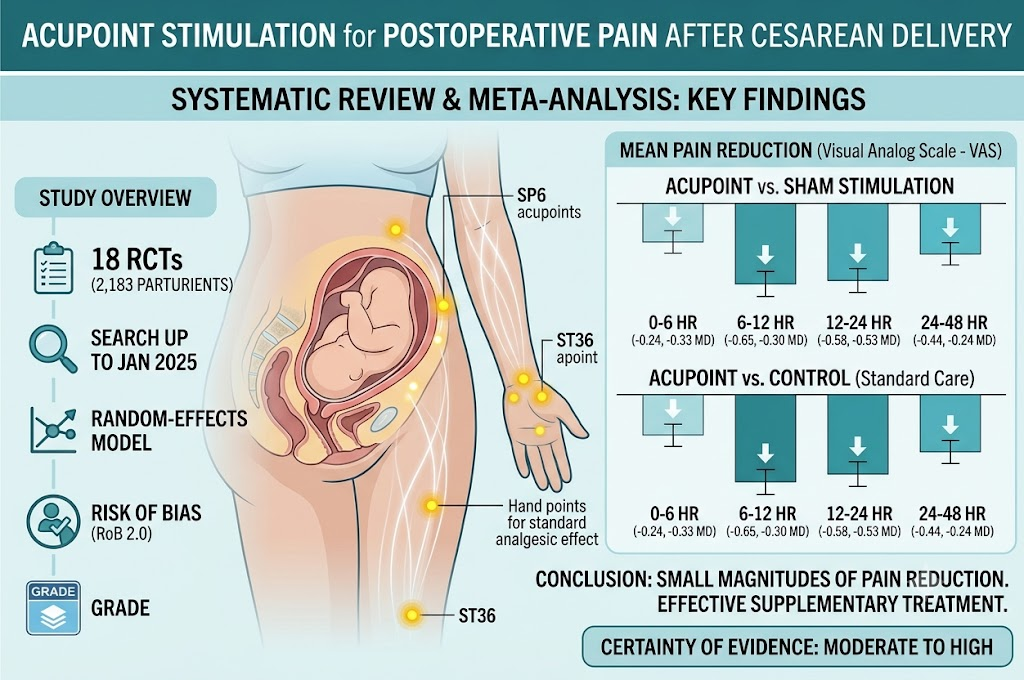
Acupoint stimulation reduced pain scores after Cesarean delivery across all time intervals up to 48 hours, with the largest reduction observed at 6–12 hours (mean difference −0.65 vs sham).
The effect was consistent compared with both sham stimulation and standard care, supported by moderate-to-high certainty evidence from 18 randomized trials.
The magnitude of pain reduction was modest (0.2–0.7 points on a typical 0–10 scale), suggesting acupoint stimulation is a supplementary, not standalone, analgesic option.
Optimal protocols for acupoint stimulation—timing, duration, and technique—remain to be determined.
Study Snapshot
Design: Systematic review and meta-analysis of randomized controlled trials.
Databases searched: PubMed, Embase, Web of Science, Scopus, Cochrane, CNKI, Airiti Library up to January 2025.
Included studies: 18 RCTs (2,183 parturients).
Comparators: Sham stimulation or standard care (control).
Primary outcome: Pain scores at ≤6 h, 6–12 h, 12–24 h, and 24–48 h postoperatively.
Key results: Statistically significant but small reductions in pain scores at all time points (mean differences ranging from −0.24 to −0.65).
Certainty of evidence: Moderate to high (GRADE).
Registration: PROSPERO CRD42024558510.
Background
Postoperative pain after Cesarean delivery affects maternal recovery, breastfeeding, and early mobility. While multimodal analgesia—including neuraxial opioids, nonsteroidal anti-inflammatory drugs, and acetaminophen—is standard, concerns about opioid-related adverse effects drive interest in nonpharmacologic adjuncts. Acupoint stimulation, encompassing techniques such as acupuncture, acupressure, and transcutaneous electrical nerve stimulation applied to traditional acupoints, has been proposed as a safe, low-cost complement. However, previous trials have yielded mixed results due to small sample sizes and heterogeneous methods.
To clarify the evidence, Vo and colleagues conducted a systematic review and meta-analysis of randomized controlled trials (RCTs) evaluating acupoint stimulation for acute pain after elective Cesarean delivery. The review, registered in PROSPERO and published ahead of print in the Canadian Journal of Anaesthesia, synthesizes data from 18 RCTs involving 2,183 parturients.
Key Advances
The meta-analysis compared acupoint stimulation with both sham stimulation and standard care (control) across four post-Cesarean time windows. Compared with sham stimulation, acupoint stimulation reduced pain scores within 6 h (mean difference [MD] −0.24; 95% CI −0.44 to −0.03), 6–12 h (MD −0.65; 95% CI −1.09 to −0.20), 12–24 h (MD −0.58; 95% CI −0.93 to −0.23), and 24–48 h (MD −0.44; 95% CI −0.88 to −0.01). Compared with standard care, the reductions were MD −0.33 (95% CI −0.52 to −0.15) within 6 h, −0.30 (95% CI −0.43 to −0.17) at 6–12 h, −0.53 (95% CI −0.79 to −0.28) at 12–24 h, and −0.24 (95% CI −0.44 to −0.03) at 24–48 h. All results reached statistical significance, and certainty of evidence was rated moderate to high using GRADE.
These findings indicate that acupoint stimulation produces a consistent but modest analgesic benefit. The effect size ranged from approximately 0.2 to 0.7 points on a typical 0–10 pain scale. The largest reduction relative to sham occurred in the 6–12 h window, a period often associated with breakthrough pain as spinal or epidural analgesia wanes.
Heterogeneity and Subgroup Considerations
The review did not provide detailed subgroup analyses by acupoint stimulation modality (e.g., acupuncture vs. acupressure) or by type of sham control. However, the overall consistency across comparisons strengthens confidence in the general effect. The authors noted that the included RCTs varied in technique, treatment duration, and acupoint selection, which may contribute to the observed heterogeneity but also limit the ability to recommend a specific protocol.
Safety and Tolerability
Although the meta-analysis did not systematically extract adverse event data, acupoint stimulation is generally considered safe when performed by trained personnel. No major complications were reported in the included trials, but the absence of systematic safety reporting is a limitation.
Expert Commentary
The clinical significance of a 0.2–0.7 point pain reduction merits careful interpretation. On a 0–10 numeric rating scale, a change of 1 point is often considered the minimal clinically important difference (MCID) in acute pain settings. By this standard, the effect of acupoint stimulation falls below the MCID for most time points. However, even small adjunctive benefits can be meaningful when they contribute to reduced opioid consumption or enhanced patient satisfaction, especially in a population highly motivated to avoid opioid exposure due to breastfeeding and neonatal concerns.
The review has notable strengths: a comprehensive search in multiple languages, rigorous risk-of-bias assessment with the RoB 2.0 tool, and GRADE evaluation. Limitations include the inability to assess opioid-sparing effects directly (opioid consumption was not a primary outcome in most trials) and the short follow-up limited to 48 hours. Furthermore, the diversity of acupoint stimulation techniques precludes a definitive “best practice” recommendation. Clinicians considering acupoint stimulation should view it as a component of multimodal analgesia rather than a replacement for pharmacologic agents.
Clinical and Translational Implications
These findings support the inclusion of acupoint stimulation in enhanced recovery after Cesarean (ERAC) protocols as a low-risk, low-cost adjunct. Hospitals with access to trained acupuncturists or nurses skilled in acupressure can implement it without significant infrastructure. However, the modest effect size underscores that acupoint stimulation should be offered alongside—not instead of—standard pharmacologic analgesia.
Future research should prioritize trials that compare standardized acupoint stimulation protocols (e.g., specific points, duration, and timing) to identify the optimal regimen. Incorporating opioid consumption as a coprimary outcome and extending follow-up beyond 48 hours would help clarify whether the pain reduction translates into reduced opioid use or improved functional recovery. Additionally, patient-reported outcomes such as satisfaction and quality of recovery should be systematically collected.
Conclusion
Acupoint stimulation provides statistically significant but modest reductions in acute pain after Cesarean delivery, based on moderate-to-high certainty evidence from 18 RCTs. The effect is consistent across sham and control comparisons and persists throughout the first 48 hours. While not a standalone solution, acupoint stimulation is a reasonable nonpharmacologic adjunct within multimodal analgesia. Clinicians and researchers should work toward standardizing protocols to maximize benefit and to evaluate downstream outcomes such as opioid use and maternal satisfaction.
References
Vo BTN, Thai TBT, Loh EW, Tsai YL, Tam KW. Effects of acupoint stimulation for postoperative analgesia after Cesarean delivery: a systematic review and meta-analysis of randomized controlled trials. Can J Anaesth. 2026 Jun 30. doi: 10.1007/s12630-026-03147-x. Epub ahead of print. PMID: 42380420.
This article was created using several editorial tools, including AI, as part of the process. Human editors reviewed this content before publication.