Highlight
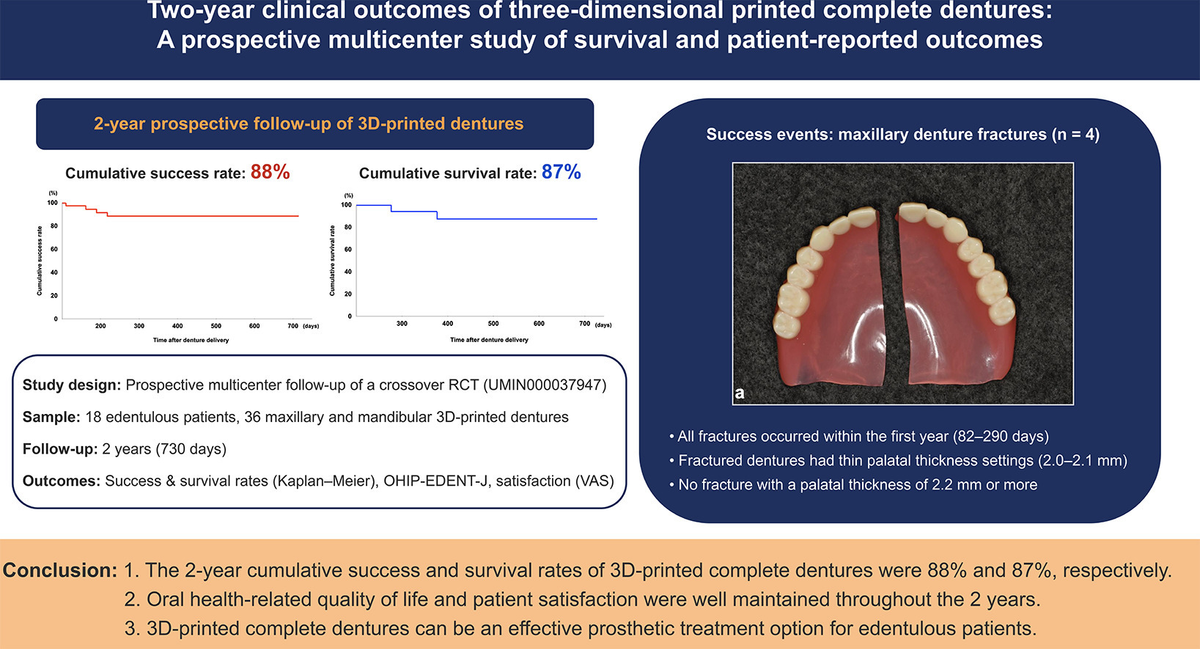
This prospective multicenter study reports on the 2-year clinical outcomes of computer-aided design and three-dimensional printing (CAD-3DP) complete dentures in edentulous patients following a randomized controlled trial. Key findings include: (1) High cumulative success (88%) and survival rates (87%) over 2 years; (2) All denture fractures occurred in maxillary prostheses with thinner palatal thickness settings (2.0-2.1 mm); (3) Oral health-related quality of life (OHRQoL) and patient satisfaction remained stable throughout follow-up; (4) Design considerations such as palatal thickness are crucial to prevent mechanical failures.
Study Background
Complete dentures remain a fundamental prosthetic solution for edentulous patients, addressing functional and aesthetic needs after tooth loss. Traditional denture fabrication can be time-consuming, technique-sensitive, and prone to inconsistencies affecting fit and durability. The advent of CAD and three-dimensional printing technologies in prosthodontics promises to streamline manufacturing, enhance customization, and potentially improve clinical outcomes. However, longitudinal data addressing the durability, patient experience, and clinical applicability of 3D-printed complete dentures are limited. This study aims to fill that gap by prospectively evaluating 2-year outcomes following initial use of CAD-3DP dentures.
Study Design
This was a prospective multicenter observational follow-up conducted after a crossover randomized controlled trial (RCT) involving 18 edentulous patients wearing maxillary and mandibular CAD-3DP complete dentures (total of 36 dentures). Participants who continued to use the 3D-printed dentures after the RCT conclusion were followed for an additional 2 years. Each denture was fabricated via CAD and additive manufacturing with specific design parameters, including a palatal thickness set between 2.0 and 2.5 mm.
Clinical endpoints included:
Success rate: Defined by freedom from events such as denture fracture, repair, relining, or occlusal reconstruction.
Survival rate: Defined as the continued use of the denture without discontinuation.
Patient-reported outcomes evaluated were:
Oral health-related quality of life (OHRQoL): Assessed via total scores and seven subdomain scores.
Patient satisfaction: Measured by visual analogue scale (VAS).
Assessments were conducted at the RCT conclusion (T0) and every 6 months through 24 months (T4).
Key Findings
Of the 18 patients, 12 (24 dentures) completed the full 2-year follow-up. The main findings were as follows:
Success and Survival Rates
The two-year cumulative success rate was 88%, with failures limited to four maxillary denture fractures occurring within the first year.
The survival rate, reflecting dentures still in use, was 87%; four dentures from two patients were discontinued following these maxillary fractures.
Fracture Analysis
All fractures occurred in maxillary dentures whose palatal thickness was at the lower end of the design range (2.0-2.1 mm), suggesting a relationship between thinner palatal thickness and increased fracture risk. This underlines the importance of appropriate denture design parameters to ensure mechanical robustness.
Patient-Reported Outcomes
OHRQoL total and subdomain scores remained stable compared to baseline (T0) throughout the follow-up period, indicating sustained functional and psychosocial benefits from the 3D-printed dentures.
Patient satisfaction measured by VAS showed no significant decline, reflecting consistent acceptance and comfort with the prostheses over 2 years.
Clinical Implications
The study demonstrated that 3D-printed complete dentures fabricated via CAD with careful attention to design can provide durable prosthetic rehabilitation with stable patient satisfaction and quality of life over a medium-term period. The findings support the clinical viability of employing 3D printing in complete denture fabrication, offering advantages including reproducibility and potential customization.
Expert Commentary
Three-dimensional printing represents a significant technological advancement in prosthodontics, enabling rapid and precise fabrication of dentures. However, mechanical properties of 3D-printed materials have been a concern, especially fracture resistance. This study provides empirical clinical data demonstrating high survival with the caveat that design features, such as palatal thickness, critically influence outcomes.
Despite the promising results, the relatively small cohort and patient dropout are limitations, underscoring need for larger-scale multicenter studies to corroborate these findings and refine fabrication protocols. Identifying optimal material properties and structural parameters will be essential to minimize mechanical failure risks.
Conclusion
Over a two-year period, CAD-3D printed complete dentures exhibited high success and survival rates with durable patient-reported outcomes. Attention to design details, particularly palatal thickness, is paramount to mitigate fracture risk, especially in maxillary prostheses. These findings endorse CAD-3DP dentures as a clinically effective and patient-friendly option for edentulous rehabilitation, advancing the integration of digital technologies in prosthodontic practice.
Funding and Clinical Trial Registration
The study was registered as UMIN000037947. Specific funding details were not reported in the abstract.
References
Iwaki M, Akiyama Y, Mukai M, Tang B, Kohri K, Masumoto M, Shibata S, Shirai M, Shimpo H, Ohkubo C, Takaichi A, Usugi SI, Kanazawa M. Two-year clinical outcomes of three-dimensional printed complete dentures: A prospective multicenter study of survival and patient-reported outcomes. Journal of Dentistry. 2026 Oct 13;107110. PMID: 42869411.