Highlight
QY201, a novel oral dual Janus kinase 1 (JAK1) and tyrosine kinase 2 (TYK2) inhibitor, demonstrated robust efficacy in adults with moderate-to-severe atopic dermatitis (AD).
The phase 2 randomized, double-blind, placebo-controlled trial showed significant improvement with QY201 at doses of 5 mg, 10 mg, and 20 mg twice daily compared with placebo, particularly in EASI-75 response rates.
Safety profile was favorable overall, with mostly mild to moderate treatment-emergent adverse events comparable to placebo, supporting dose selection for phase 3 studies.
Study limitations include relatively short 12-week follow-up and enrollment limited to a single country, warranting further global investigation.
Study Background and Disease Burden
Atopic dermatitis is a chronic, relapsing inflammatory skin disease characterized by intense pruritus, eczematous lesions, and significant impact on quality of life. Moderate-to-severe AD often requires systemic treatment due to persistent symptoms and frequent flares. Although biologics and conventional systemic immunosuppressants are available, limitations exist, including incomplete efficacy and safety concerns. Janus kinase (JAK) inhibitors targeting cytokine signaling involved in AD pathogenesis have emerged as promising therapeutic options. QY201 is an oral small-molecule dual inhibitor of JAK1 and TYK2, enzymes crucial in inflammatory pathways implicated in AD, potentially offering a novel therapeutic mechanism with an improved safety profile.
Study Design
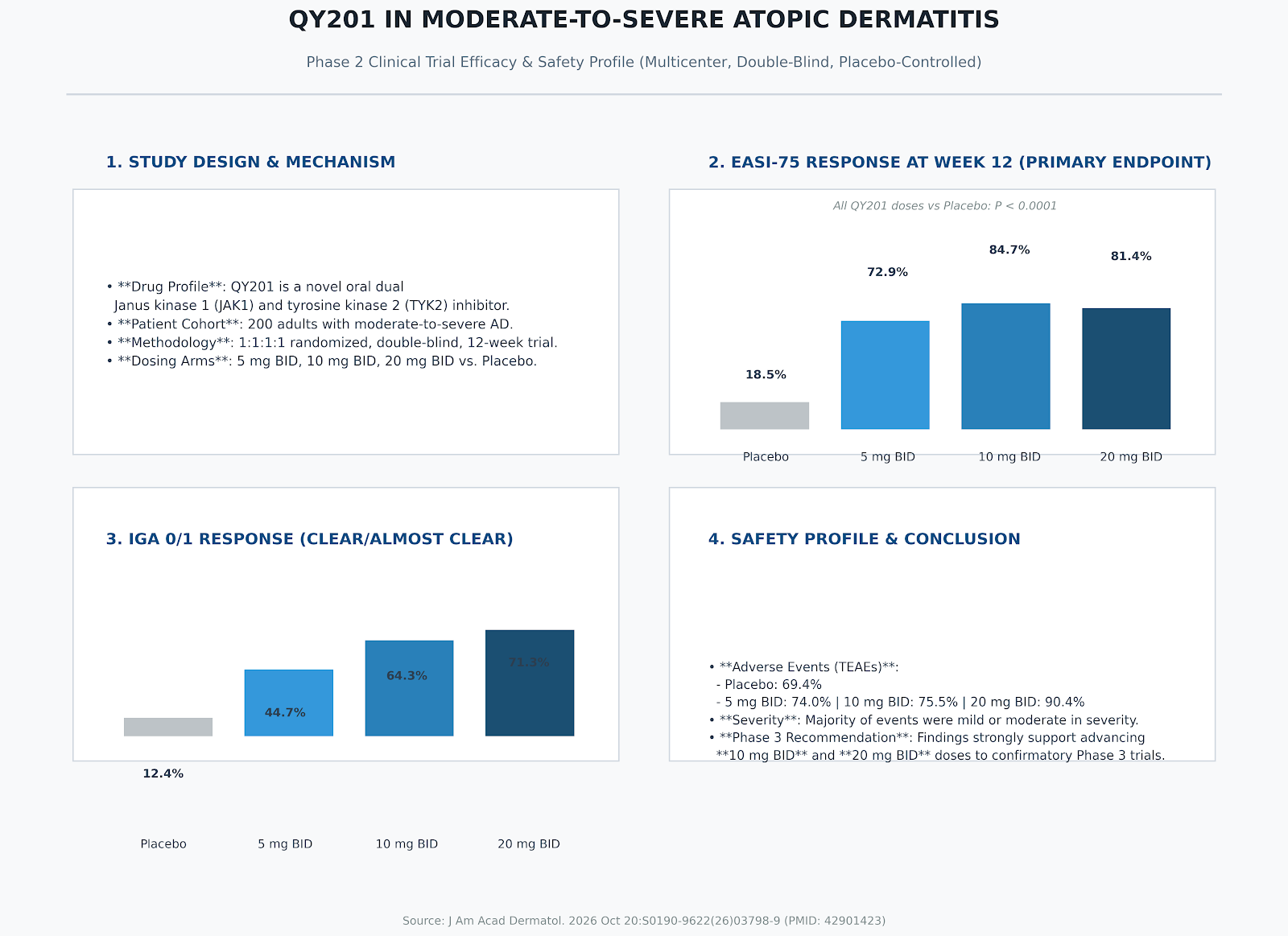
This multicenter, randomized, double-blind, placebo-controlled phase 2 trial enrolled 200 adults with moderate-to-severe AD. Participants were randomized equally into four groups to receive either QY201 at doses of 5 mg, 10 mg, or 20 mg twice daily (BID) or placebo for 12 weeks. The primary endpoint was the proportion of patients achieving at least 75% improvement from baseline in the Eczema Area and Severity Index (EASI-75) at week 12. Secondary endpoints included the Investigator’s Global Assessment (IGA) response rate and safety assessments through monitoring treatment-emergent adverse events (TEAEs).
Key Findings and Results
The trial demonstrated statistically and clinically significant improvements in eczema severity with QY201 compared to placebo. At week 12, EASI-75 response rates were 72.9% in the 5 mg BID group, 84.7% in the 10 mg BID group, and 81.4% in the 20 mg BID group, versus 18.5% in the placebo group (all P<0.0001). These rates indicate substantial skin clearance or near-clearance in the majority of treated patients.
IGA responder rates, defined as clear or almost clear skin, were 44.7% (P=0.0011), 64.3% (P<0.0001), and 71.3% (P<0.0001) in the 5 mg, 10 mg, and 20 mg BID groups, respectively, compared with 12.4% in the placebo group, reflecting consistent clinical improvements across efficacy measures.
Regarding safety, TEAEs were reported in 74.0%, 75.5%, and 90.4% of patients in the 5 mg, 10 mg, and 20 mg BID groups, respectively, compared with 69.4% in the placebo group. Notably, most adverse events were mild or moderate, with no unexpected safety signals noted. The slightly higher rate in the 20 mg group warrants attention but did not translate into severe or treatment-limiting events.
Expert Commentary
The results of this phase 2 trial align with the growing evidence supporting JAK inhibitors as effective therapies for moderate-to-severe AD. Dual inhibition of JAK1 and TYK2 by QY201 potentially modulates key cytokine pathways, including IL-4, IL-13, and interferons, which contribute to AD pathophysiology. The observed high EASI-75 and IGA response rates at 10 mg and 20 mg BID doses suggest strong clinical effects with manageable tolerability.
Compared to other JAK inhibitors investigated in AD, QY201’s profile may offer a favorable balance between efficacy and adverse events, though direct comparative data are lacking. Limitations include the 12-week duration, insufficient for long-term safety and durability assessment, and geographic restriction limiting generalizability. Larger, diverse populations studied over longer periods in phase 3 trials will better define QY201’s clinical utility.
Conclusion
This phase 2 dose-finding trial demonstrated that QY201 significantly improves moderate-to-severe atopic dermatitis symptoms with an acceptable safety profile. The findings support continued clinical development of QY201 at 10 mg and 20 mg twice daily doses in confirmatory phase 3 studies. If validated, QY201 may become a valuable oral therapeutic option addressing unmet needs in AD management.
Funding and Clinical Trial Registration
The study was supported by the developer of QY201. Clinical trial registration details were not provided in the abstract.
References
1. Wang T, Li J, Liang Y, et al. Efficacy and safety of QY201, an oral dual Janus kinase 1/tyrosine kinase 2 inhibitor, in adults with moderate-to-severe atopic dermatitis: a multicenter, randomized, double-blind, placebo-controlled phase 2 dose-finding trial. J Am Acad Dermatol. 2026 Oct 20. PMID: 42901423.
2. Abdel-Malek ZA, Krueger JG. Current and emerging treatment strategies for atopic dermatitis. Nat Rev Dermatol. 2022;18(5):265-284.
3. Guttman-Yassky E, Silverberg JI, Nemoto O, et al. Baricitinib in patients with moderate-to-severe atopic dermatitis: A Global Phase 3 Randomized Safety and Efficacy Study. Br J Dermatol. 2021;185(2):356-365.
4. Simpson EL, Bieber T, Guttman-Yassky E, et al. Two Phase 3 Trials of Dupilumab versus Placebo in Atopic Dermatitis. N Engl J Med. 2016;375(24):2335-2348.