Aging is a universal phenomenon that profoundly affects the function and adaptability of all living organisms over time. Widely observed across diverse species, it is characterized by the progressive decline of cells, tissues, and organs, the accumulation of cellular and molecular damage, diminished regenerative capacity, and the loss of resilience to stressors.
Many hallmarks of aging share a common feature—the onset of chronic low-grade inflammation (also known as inflammaging), which accelerates tissue degradation and disrupts metabolic and regenerative pathways across multiple organ systems. Although inflammaging was originally viewed as a downstream consequence of aging, mounting evidence suggests that persistent inflammatory signaling itself is a powerful driver of biological aging.
On November 12, 2026, researchers from Monash University published a study in the journal Immunity (a sister journal of Cell) titled:
"Granzyme K is a driver of age-related tissue remodeling and functional decline independently of age-associated immune dysfunction."
This study reveals that Granzyme K (GzmK), which is derived from T cells and increases with age, drives age-related tissue fibrosis and organ dysfunction but does not contribute to immune aging (immunosenescence). These findings demonstrate that biological aging and immune aging can be decoupled, identifying GzmK as a potential anti-aging target that could promote healthy aging without compromising immune function.
Aging is characterized by the progressive decline of tissue and organ function, with chronic low-grade inflammation (inflammaging) widely considered a core driver. Granzyme K (GzmK), a serine protease, is significantly upregulated in aging memory CD8⁺ T cells, leading researchers to suspect it might serve as a shared core mediator of both immune aging and biological aging.
In this latest study, the research team utilized young and aged GzmK-deficient () mice to investigate its role. They discovered that while GzmK is not essential for the primary features of immune aging—including T-cell dysfunction—it acts as a critical driver of age-related tissue decline. Even though the phenotypes of immune aging persisted, the absence of GzmK significantly alleviated organ degeneration, effectively decoupling immune aging from organismal (biological) aging.
In the kidneys, this mitigation was associated with reduced complement deposition.
In the liver, functional improvement and reduced fibrosis occurred independently of the complement system; instead, they were accompanied by an increase in decorin (a core proteoglycan) and a attenuation of pro-fibrotic TGF-β signaling.
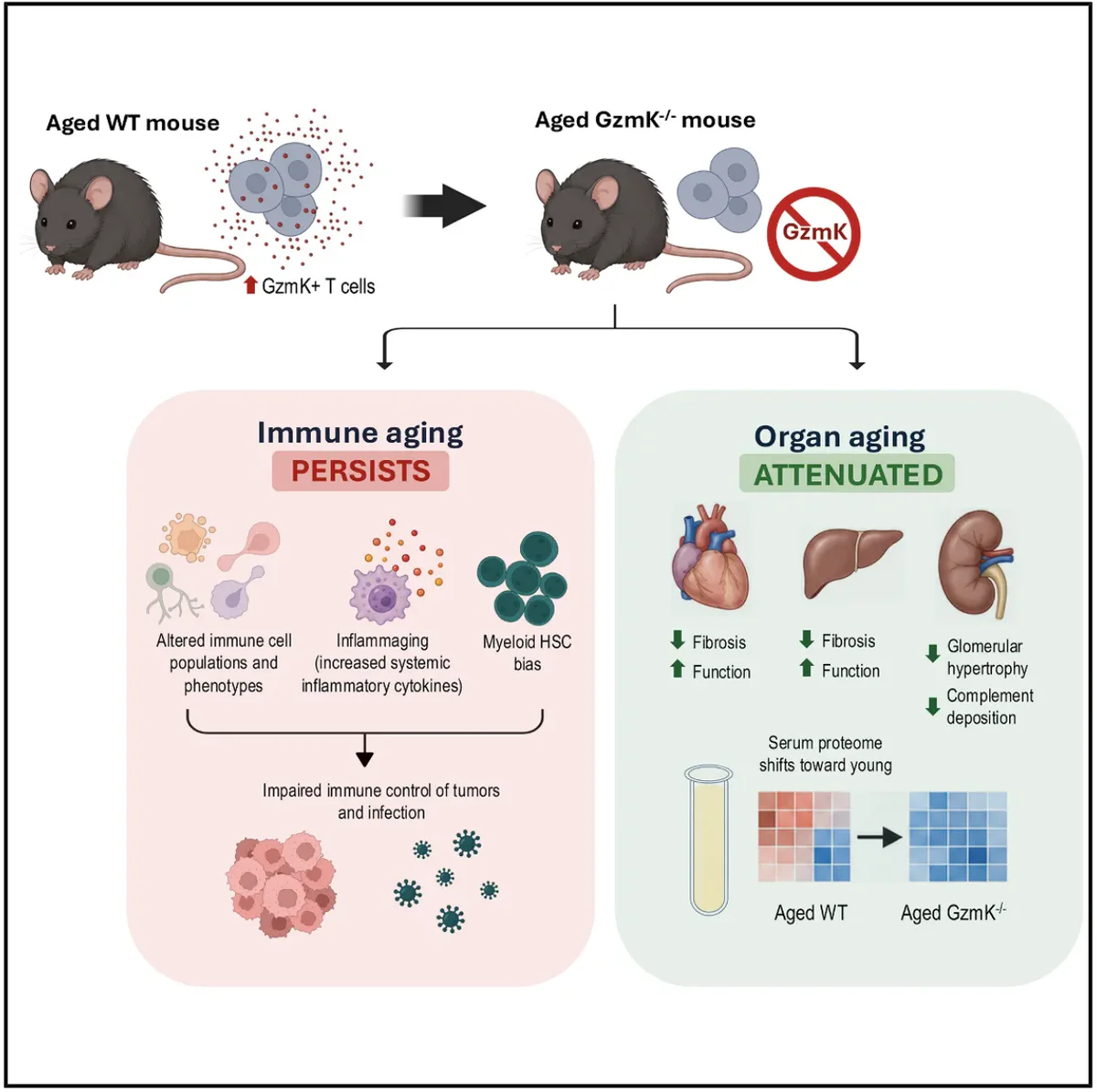
In conclusion, these findings demonstrate that GzmK is a tissue-specific driver of biological aging, rather than a driver of immune aging or systemic inflammaging.
Original Link:
https://www.cell.com/immunity/fulltext/S1074-7613(26)00440-1