We use cookies

Our website uses essential cookies and, with your consent, additional cookies to measure performance and improve our services. Cookie Policy.

You can change your choice at any time.

MMedXYNews
HomeVideos
MedXY AI/MedXY News/Section: Allergy & Immunology

Decoding the Immune Landscape of COPD: Single-Cell RNA Sequencing Reveals Profibrotic Macrophage and Monocyte Niches Driving Disease Progression
MedXY Editorial Team•Aug 4, 2026•Allergy & Immunology
MacrophagesCOPDsingle-cell sequencingmonocytesimmune dysregulation

Highlight

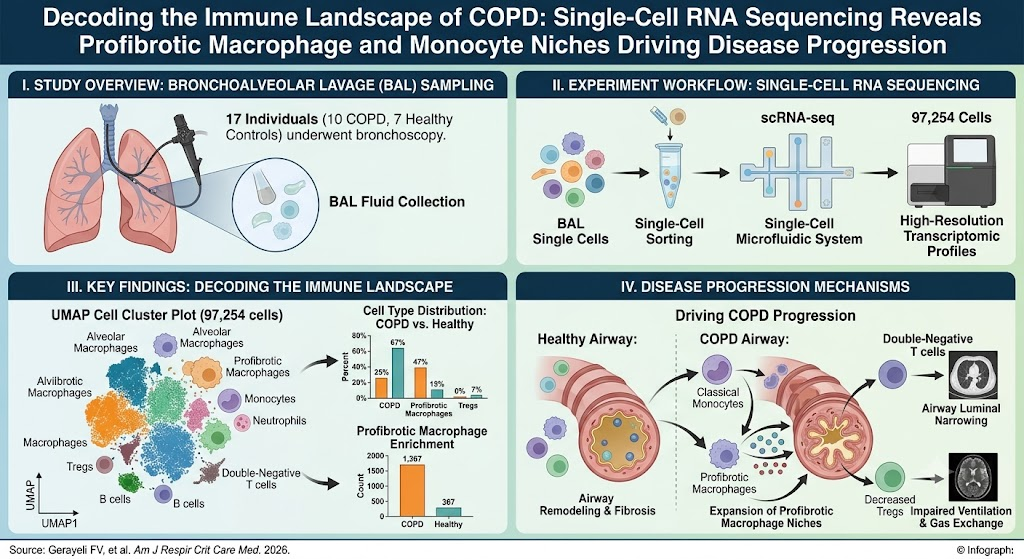
1. Single-cell RNA sequencing of bronchoalveolar lavage (BAL) cells from COPD patients reveals marked alterations in immune cell composition compared to healthy controls.

2. There is an increased abundance of proinflammatory and profibrotic macrophages, classical monocytes, and neutrophils in COPD airways, contributing to disease pathology.

MedXY registered readers

Sign in free to continue reading

Create or use your MedXY account to unlock the complete article.

This article was created using several editorial tools, including AI, as part of the process. Human editors reviewed this content before publication.

Related articles

Open language-specific specialty feeds and department pages.

Comparative Skeletal Risks of COPD and Type 2 Diabetes Mellitus: Insights from a Nationwide Propensity-Matched CohortThis study reveals that COPD poses a greater risk to bone health than T2DM, with combined COPD and T2DM further increasing osteoporosis and fracture risk, especially in men, emphasizing the need for targeted bone health screening.Sep 27, 2026Innovative Cryospray Therapy Shows Promise for Chronic Bronchitis in COPD Patients: Insights from the SPRAY-CB TrialMetered-dose liquid nitrogen cryospray significantly improves quality of life and reduces severe exacerbations in COPD patients with chronic bronchitis, with a favorable safety profile demonstrated in a recent sham-controlled trial.Sep 27, 2026Mixed Mucus Plug-Emphysema Subtype and Acute Exacerbation in Chronic Obstructive Pulmonary Disease: A Quantitative CT Phenotyping ApproachQuantitative CT-defined mucus plugs combined with emphysema severity stratify COPD patients into distinct subtypes that predict risk of acute exacerbations, enabling personalized risk assessment and targeted preventive strategies.Sep 25, 2026
Loading comments...
MedXY briefing

Get the free newsletter

Evidence-led clinical news, trends, and analysis—delivered to your inbox.

Ask MedXY AI

Most popular

Intimate Health
Five Benefits for Women Continuing Sexual Activity After Menopause
Intimate Health
Why Some Women Have a Strong Sex Drive—And Why Men Shouldn't Worry About It
Nursing & care
How often should a couple have sex?
General Surgery
Optimizing Postoperative Opioid Prescriptions After Intra-Abdominal Cancer Surgery: Comparing the 5x-Multiplier and 3-Tier Models
Intimate Health
Classic Intimacy Recommendations: How to Help Women Reach Orgasm and Enjoy Mutual Pleasure
© 2026 MedXY
Contact usAbout usPrivacy PolicyMedXY story
Quantitative CT-Based Mixed Mucus Plug-Emphysema Phenotyping Predicts Exacerbation Risk in COPD: Integrating Imaging Biomarkers for Precision Medicine
This review synthesizes recent evidence on quantitative CT markers of mucus plugging and emphysema in COPD, highlighting their combined impact on acute exacerbation risk and clinical heterogeneity, and discusses implications for personalize
Sep 24, 2026
HBV-Induced Immunosuppressive Macrophages: Metabolic and Epigenetic Pathways Driving Chronic Hepatitis B PersistenceThis article reviews recent evidence on how HBV manipulates monocyte-to-macrophage differentiation through metabolic and epigenetic reprogramming, facilitating immunosuppression and chronic infection.Sep 21, 2026
Astegolimab for Chronic Obstructive Pulmonary Disease with Frequent Exacerbations: Insights from the Pooled ALIENTO and ARNASA TrialsAstegolimab, an anti-ST2 monoclonal antibody, significantly reduced moderate/severe exacerbations in COPD patients with frequent exacerbations in pooled ALIENTO and ARNASA analyses, showing promise for targeting the IL-33/ST2 pathway with gSep 13, 2026