Hyperthyroidism Atrial Fibrillation
For a patient with a strong suspicion of hyperthyroidism presenting with rapid atrial fibrillation, what injectable medication should be used to control the ventricular rate?
For a patient with suspected hyperthyroidism presenting with rapid atrial fibrillation (AF), the preferred injectable medication for acute ventricular rate control is a **beta-blocker**, specifically **intravenous propranolol** or **intravenous esmolol**.
**Conclusion:** Intravenous beta-blockers (propranolol or esmolol) are the first-line agents for acute rate control in AF associated with hyperthyroidism.
### Clinical Rationale
1. **Pathophysiology:** Hyperthyroidism increases catecholamine sensitivity and directly enhances AV nodal conduction, leading to a rapid ventricular response. Beta-blockers directly antagonize these effects, providing both rate control and symptomatic relief (e.g., palpitations, tremor).
2. **Guideline-Supported Agent Selection:**
- **Propranolol:** A non-selective beta-blocker that is particularly useful in thyrotoxicosis because it also inhibits the peripheral conversion of T4 to T3, offering a dual benefit in this specific context [6].
- **Esmolol:** An ultra-short-acting, cardioselective beta-1 blocker. Its rapid onset and short half-life make it an excellent choice for acute titration, especially in patients with labile blood pressure or when a quick offset is desired for safety [1][6].
3. **Contraindication Screening:** Before administration, it is critical to rule out acute decompensated heart failure (HF) with hypoperfusion or significant hypotension, as beta-blockers are negative inotropes and are contraindicated in this setting [5][6].
### Treatment Algorithm for Acute Rate Control in AF with Suspected Hyperthyroidism
**Step 1: Assess Hemodynamic Stability**
- **Hemodynamically Unstable** (Hypotension, acute HF, altered mental status): Proceed to **immediate electrical cardioversion** [5].
- **Hemodynamically Stable**: Proceed to pharmacological rate control.
**Step 2: Initiate Pharmacological Rate Control**
- **First-Line (Preferred): Intravenous Beta-Blocker**
- **Propranolol:** 1 mg IV bolus over 1 minute, repeated every 2-3 minutes up to a total of 10 mg, titrated to heart rate response.
- **Esmolol:** 500 mcg/kg IV bolus over 1 minute, followed by a continuous infusion starting at 50 mcg/kg/min, titrated by 25-50 mcg/kg/min every 5-10 minutes to achieve target heart rate (max 200-300 mcg/kg/min) [1][6].
- **Alternative (If Beta-Blockers are Contraindicated):**
- **Non-Dihydropyridine Calcium Channel Blocker (ND-CCB):** Intravenous **diltiazem** (0.25 mg/kg IV bolus over 2 minutes, followed by 5-15 mg/hr infusion) is an effective alternative for rate control. However, it is **contraindicated** in patients with moderate-to-severe LV dysfunction or decompensated HF [4][6].
**Step 3: Second-Line Options (If above fails)**
- **Intravenous Digoxin:** 0.5 mg IV over 30 minutes. It has a slower onset and is less effective in hyperthyroid states due to increased digoxin clearance and reduced sensitivity [1][7].
- **Intravenous Amiodarone:** 300 mg IV over 60 minutes. Reserved for critically ill patients or those with HF where beta-blockers and ND-CCBs are contraindicated [5][7]. Note: Amiodarone contains high levels of iodine and can potentially exacerbate hyperthyroidism (amiodarone-induced thyrotoxicosis type 2), so its use in this specific scenario requires careful consideration.
**The following flowchart illustrates the general Emergency Department management algorithm for AF, including the decision branch for rate control:**
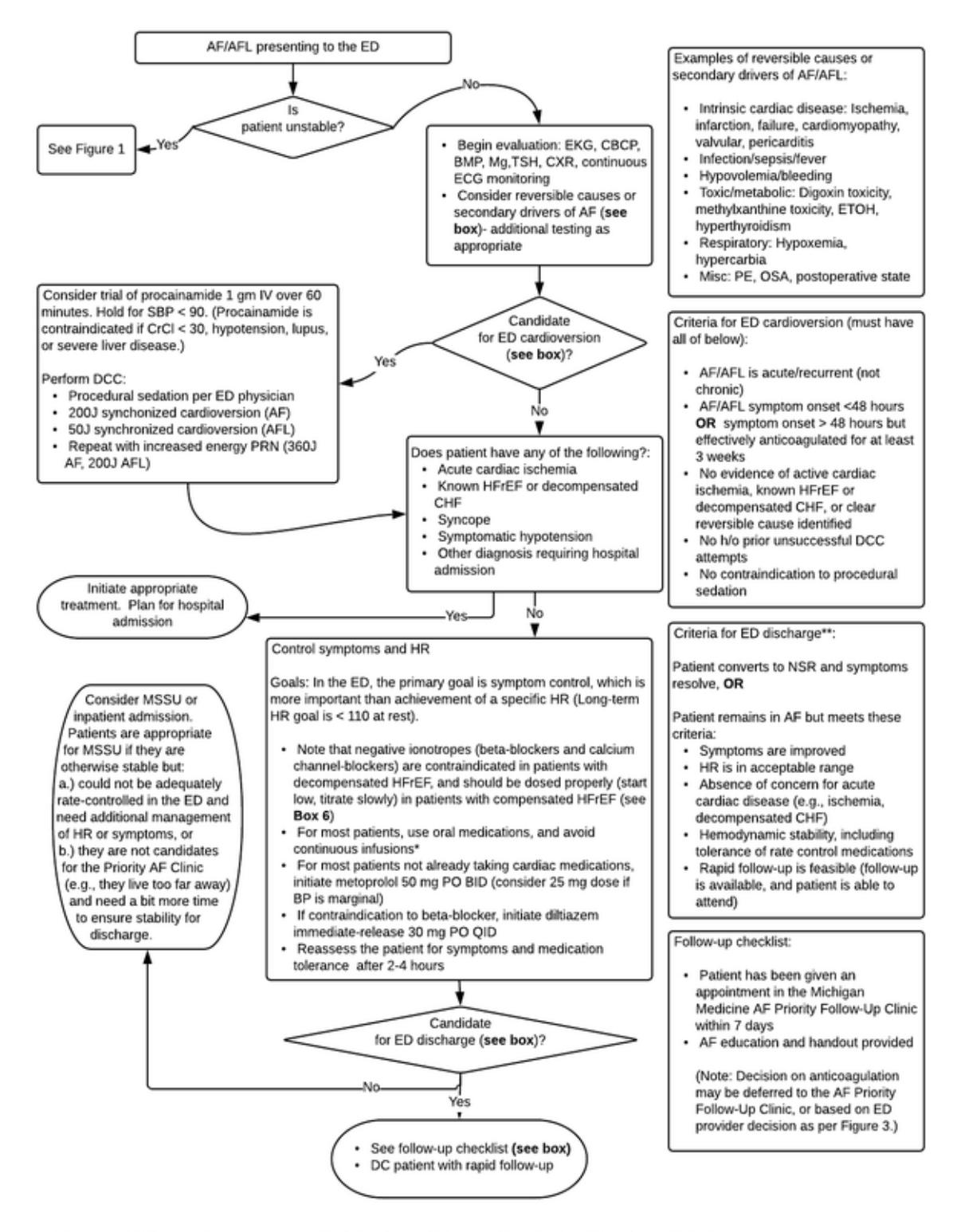
*Figure: Clinical flowchart for managing AF/AFL in the Emergency Department, covering stabilization, cardioversion, rate control, and discharge criteria.*
### Therapeutic Target
- **Resting Heart Rate:** Target < 110 bpm (lenient rate control) [1][6]. A stricter target of < 80 bpm may be considered if symptoms persist despite lenient control.
### Critical Safety Note
- **Avoid** using beta-blockers or ND-CCBs in patients with **decompensated HFrEF and hypoperfusion** [6].
- **Avoid** using ND-CCBs (diltiazem, verapamil) in patients with **Wolff-Parkinson-White (WPW) syndrome** and pre-excited AF, as they can accelerate conduction via the accessory pathway, potentially leading to ventricular fibrillation [1][4].
---
### Further Diagnostic Suggestions (Reference Only)
To enable a more accurate assessment, if available, please consider providing:
- **Thyroid Function Tests (TSH, Free T4, Free T3):** To confirm the diagnosis of hyperthyroidism and guide definitive therapy.
- **Echocardiogram:** To assess left ventricular systolic function (LVEF) and rule out structural heart disease, which is critical for selecting the appropriate rate-control agent.