Aortic Valve Stenosis Treatment
The patient has aortic valve degeneration with severe stenosis requiring surgical intervention. Please recommend several surgical options—including the types of valve materials—identify the most suitable approach, and provide the rationale for that choice.
For a patient with severe aortic stenosis requiring surgical intervention, the primary decision involves choosing between surgical aortic valve replacement (SAVR) and transcatheter aortic valve implantation (TAVI), and within SAVR, between a mechanical or bioprosthetic valve. The most suitable approach is determined by a Heart-Kidney Team evaluation, weighing patient age, life expectancy, bleeding risk, anticoagulation candidacy, and the need for future reintervention.
### Clinical Evidence & Efficacy
The standard of care for severe symptomatic aortic stenosis (AS) or asymptomatic AS with reduced LVEF (<50%) is aortic valve intervention [6]. The choice of intervention is a shared decision-making process that considers lifetime risks and benefits [8].
**Surgical Aortic Valve Replacement (SAVR)** is the established, safe, and effective procedure for most patients requiring intervention for aortic regurgitation and stenosis [1][6]. It involves replacing the native valve with a prosthesis.
**Transcatheter Aortic Valve Implantation (TAVI)** is an alternative for patients at high or prohibitive surgical risk, and its indications are expanding based on randomized trials [3][8]. The choice between SAVR and TAVI is guided by patient age, surgical risk scores (e.g., STS PROM), and anatomical suitability [3].
### Valve Material Options
The two main types of prosthetic valves for SAVR are mechanical and bioprosthetic. The choice is influenced by patient age, values, and the risks of long-term anticoagulation versus valve deterioration [1][3].
| Feature | Mechanical Valve | Bioprosthetic Valve |
| :--- | :--- | :--- |
| **Durability** | High; lasts longer than bioprosthetic valves [5]. | Limited; risk of structural valve deterioration (SVD) increases over time, especially in younger patients [3]. |
| **Anticoagulation** | **Requires lifelong vitamin K antagonist (VKA) therapy** [1][5]. | Generally does **not** require long-term anticoagulation [2]. |
| **Primary Risk** | Thromboembolism and major bleeding from anticoagulation (4.4% and 8.5% per year, respectively, in non-hemophilia populations) [2]. | Structural valve deterioration requiring reoperation or valve-in-valve TAVI [3]. |
| **Preferred Patient Profile** | Patients aged <60 years, those at high risk of valve deterioration (e.g., age <40, hyperparathyroidism), and those with high risk of redo surgery [1]. | Patients aged >65 years, those with contraindications to or poor quality anticoagulation, and young women contemplating pregnancy [1]. |
### Guideline Recommendations for Valve Selection
The following table summarizes key recommendations from the *Oxford Handbook of Cardiology* [1]:
| Category | Recommendation | Strength |
| :--- | :--- | :--- |
| **Anticoagulation** | Bioprosthetic: where good-quality anticoagulation is unlikely or contraindicated due to bleeding risk. | I |
| **Thrombus** | Bioprosthetic: if reoperating for mechanical valve thrombosis despite good anticoagulation. | I |
| **Valve deterioration** | Mechanical: in patients at high risk of valve deterioration (age <40 years, hyperparathyroidism). | I |
| **Patient age** | Mechanical: patients aged <60 years. | IIa |
| **Patient age** | Bioprosthetic: patients aged >65 years. | IIa |
| **Pregnancy** | Bioprosthetic: should be considered in young women contemplating pregnancy. | IIa |
| **Risk of redo surgery** | Mechanical: should be considered in patients with high risk of redo valve surgery. | IIa |
### Decision Algorithm for Intervention (SAVR vs. TAVI)
The following algorithm from the 2023 Korean Society of Echocardiography position paper illustrates the decision-making process for choosing between SAVR and TAVI in patients with severe AS [3].
**The following flowchart illustrates the clinical decision algorithm for choosing between TAVR and SAVR in patients with severe aortic stenosis:**
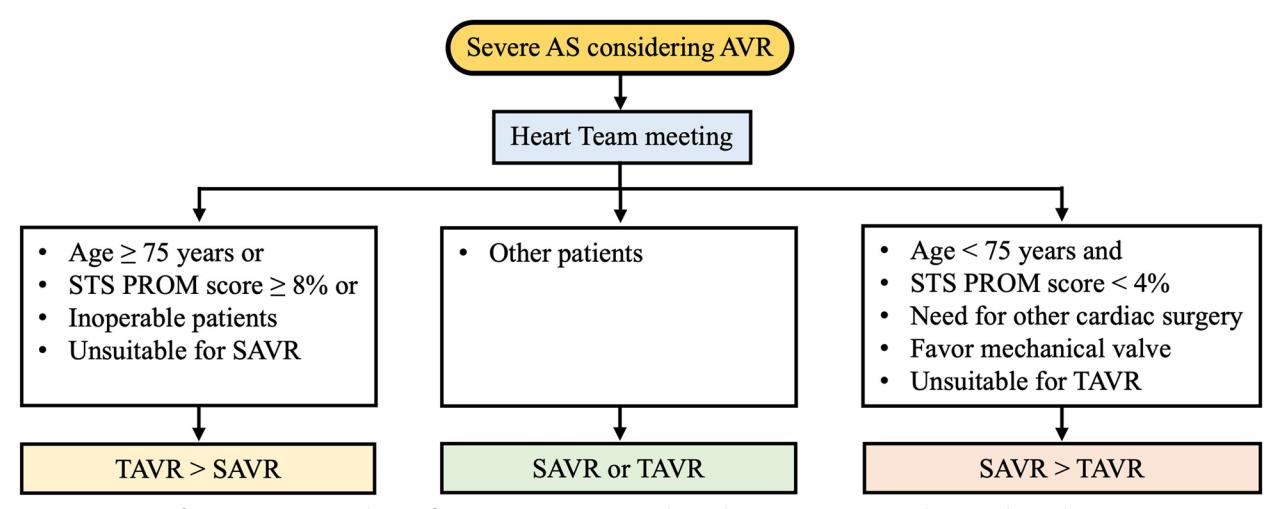
*Figure: Clinical decision algorithm for choosing between TAVR and SAVR in patients with severe aortic stenosis based on age, surgical risk, and clinical suitability.*
### Special Considerations: Chronic Kidney Disease (CKD)
For patients with CKD, the risk-benefit calculus shifts. The risk of major bleeding is inversely related to eGFR and increases with microalbuminuria and anticoagulant therapy [9]. The mortality benefit of mechanical valves is thought to accrue only in patients with a life expectancy beyond 8-10 years [9]. The emergence of TAVR as a less invasive option for bioprosthetic valve degeneration is also a key consideration [9].
**The following algorithm from the AHA Scientific Statement provides a suggested approach to valve selection in patients with CKD:**
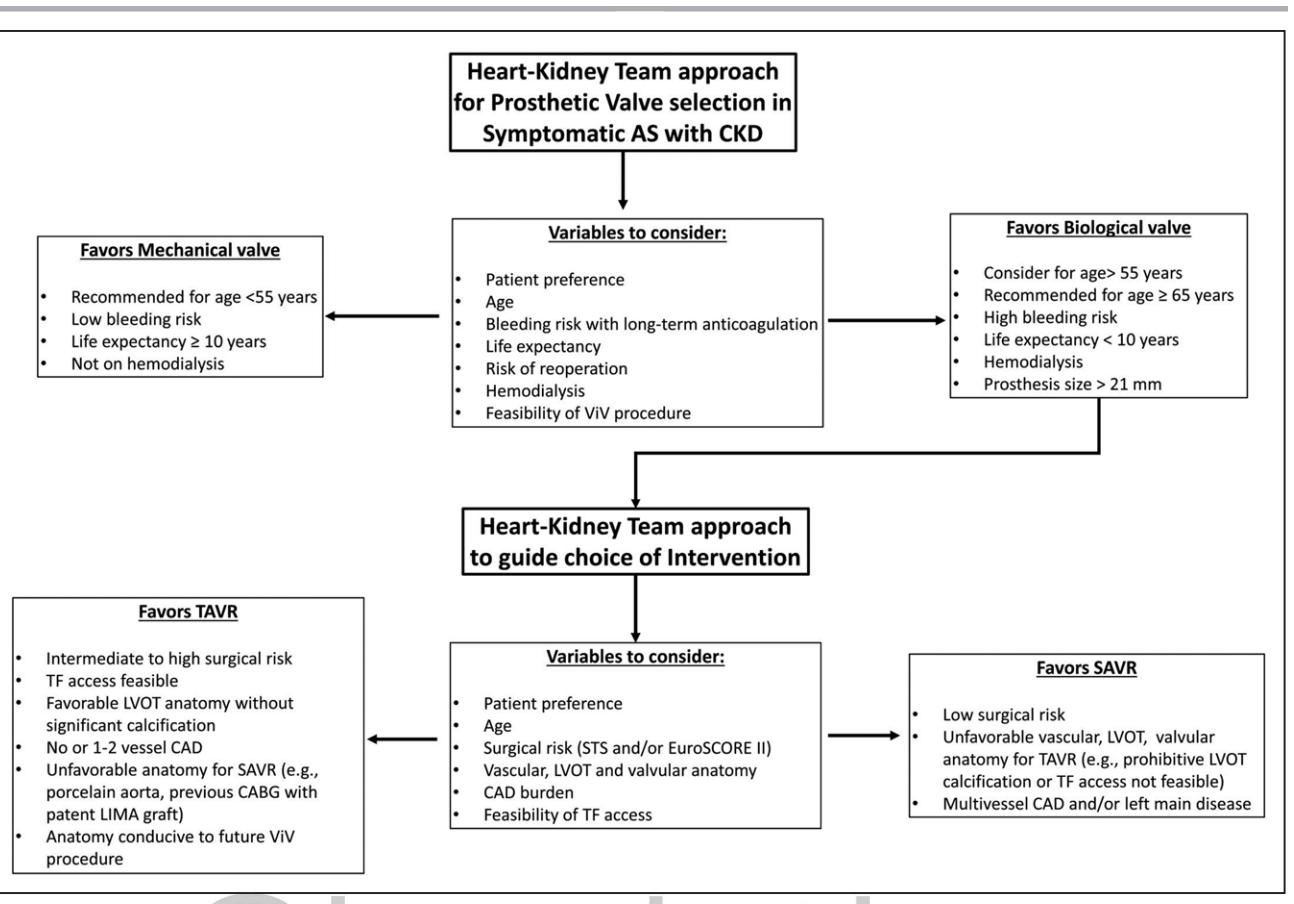
*Figure: A multidisciplinary Heart-Kidney Team algorithm for selecting prosthetic valve types and intervention methods (TAVR vs. SAVR) in patients with symptomatic aortic stenosis and chronic kidney disease.*
### Conclusion
The optimal surgical approach for severe aortic stenosis is patient-specific. For a younger patient (<60 years) without contraindications to anticoagulation, a **mechanical valve via SAVR** is recommended for its superior durability. For an older patient (>65 years) or one with a high bleeding risk, a **bioprosthetic valve** (via SAVR or TAVI) is preferred to avoid lifelong anticoagulation. A multidisciplinary Heart-Kidney Team evaluation is essential to integrate all clinical factors and patient preferences into the final decision.
---
*This analysis is based on retrieved clinical guidelines and literature. Clinical decisions should be individualized based on a comprehensive patient evaluation and multidisciplinary team discussion.*