NSTEMI Management Flowchart
Please provide a flowchart illustrating the management of NSTEMI in patients with atrial fibrillation receiving oral anticoagulant therapy.
**Conclusion**: In NSTEMI patients with AF on OAC, the recommended antithrombotic strategy is a short period of triple therapy (up to 1 week), followed by dual therapy (DOAC + clopidogrel) for 6–12 months, with continuation of OAC alone thereafter.
## Clinical Evidence & Recommendations
### Antithrombotic Strategy in NSTEMI with AF
**Initial Management (Acute Phase)**
- All patients should receive a loading dose of aspirin 150–300 mg (Class I, Level A)[1].
- For patients already on OAC, the European guidelines recommend **continuing oral anticoagulation** rather than bridging[1]. This is based on the WOEST trial subgroup analysis showing no significant difference in bleeding or major adverse events between uninterrupted OAC and bridging therapy during PCI[1].
- Low-dose parenteral anticoagulation may be added to direct OAC, though the safety of bridging direct OAC with parenteral anticoagulation remains unclear[1].
- For patients on VKA with INR >2.5, **no additional parenteral anticoagulation** is recommended[1].
**Post-Procedural Antithrombotic Regimen**
The CVIT 2022 consensus recommends[2]:
- **Triple therapy**: Up to **1 week** from the acute event (aspirin + P2Y12 inhibitor + OAC)
- **Dual therapy**: DOAC + single oral antiplatelet agent (preferably **clopidogrel**) for **6–12 months**
- **Long-term**: OAC alone after 6–12 months, with cessation of antiplatelet therapy
**The following flowchart summarizes the management pathway:**
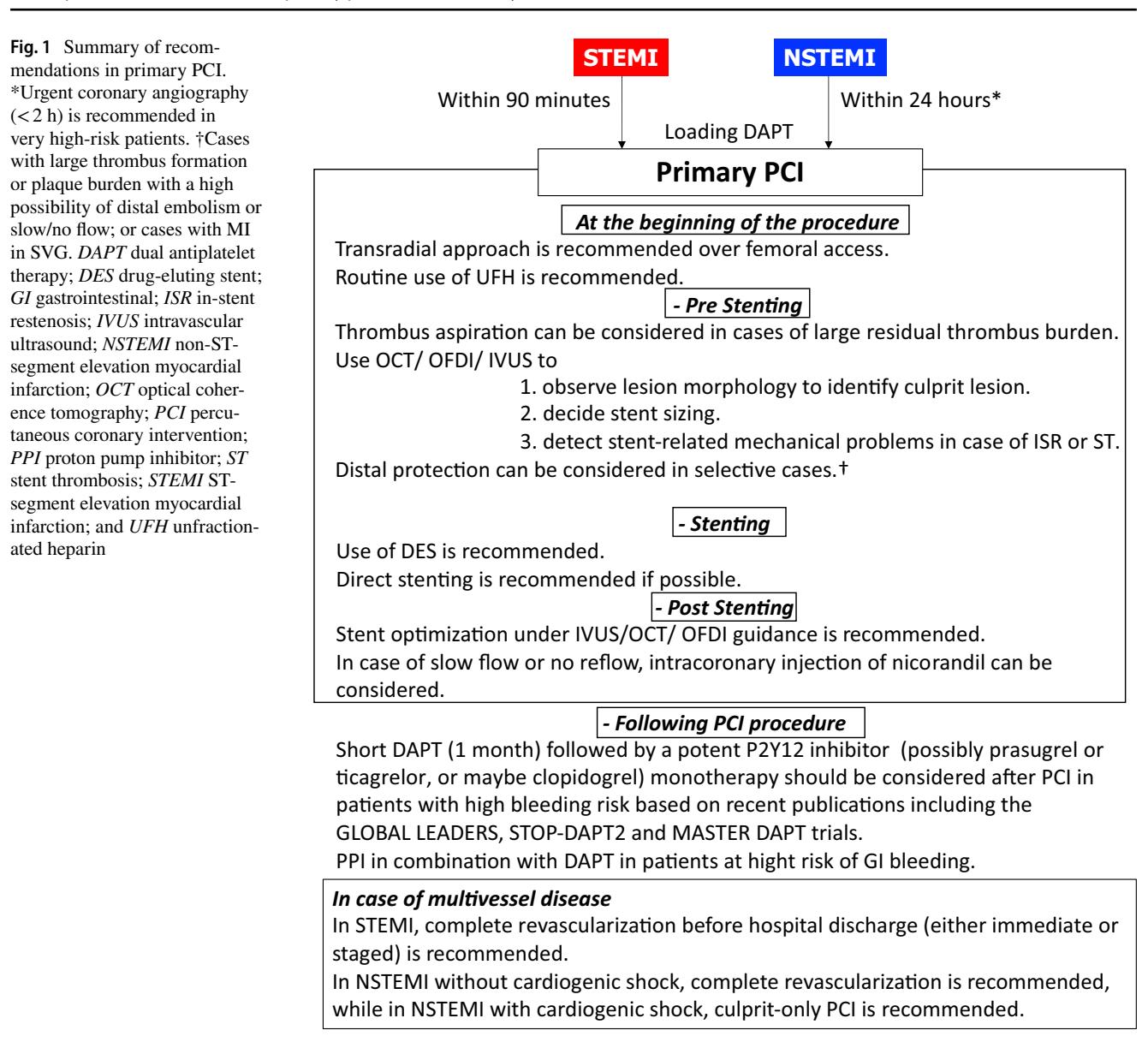
*Figure: Comprehensive clinical flowchart summarizing recommendations for primary PCI in STEMI and NSTEMI patients, covering timing, procedural techniques, and post-procedural management*
### Key Procedural Considerations
- **Primary PCI** is the preferred revascularization strategy[1].
- An **early invasive strategy within 24 hours** is recommended for NSTEMI (Class I)[2].
- **Complete revascularization** in NSTEMI patients without cardiogenic shock is considered a **Class IIa** recommendation[2].
### Critical Gaps in Current Evidence
- The safety of discontinuing direct OAC without parenteral anticoagulation is unclear[1].
- The optimal duration of dual therapy (6 vs. 12 months) requires individualized assessment based on bleeding and ischemic risk.
- Direct application of European guidelines to non-European populations (e.g., Japanese) may be limited by differences in device approval and available medical therapy[2].
---
**Disclaimer**: This content is AI-generated based on retrieved literature and is intended for clinical reference only. Please verify recommendations against current official drug labeling and apply individual patient judgment in clinical decision-making.
Please generate a new flowchart.
**Conclusion**: Based on the 2024 CVIT consensus and 2023 ACC/AHA guidelines, the recommended antithrombotic strategy for NSTEMI patients with AF on OAC is: triple therapy (OAC + aspirin + clopidogrel) for up to 1 month in high-ischemic-risk patients, followed by dual therapy (OAC + clopidogrel) for up to 12 months, then OAC monotherapy thereafter.
## Clinical Management Flowchart
**The following flowchart illustrates the stepwise management of NSTEMI in patients with atrial fibrillation receiving oral anticoagulant therapy:**
```mermaid
flowchart TD
Start(("NSTEMI + AF<br>Patient")) --> Assess["Assess Stroke Risk<br>CHA₂DS₂-VASc Score"]
Assess --> D1{"CHA₂DS₂-VASc<br>≥2 (Men) or ≥3 (Women)?"}
D1 -->|"Yes"| OAC["Initiate/Continue OAC<br>(DOAC preferred over Warfarin)<br>(Class I, Level A)"]
D1 -->|"No"| NoOAC["OAC Not Indicated<br>Consider Antiplatelet Only"]
OAC --> D2{"Bleeding Risk<br>Assessment<br>(HAS-BLED Score)"}
subgraph Acute["Acute Phase Management"]
direction TB
D2 -->|"HAS-BLED <3"| Std["Standard Antithrombotic<br>Strategy"]
D2 -->|"HAS-BLED ≥3"| Caution["Heightened Bleeding<br>Risk Precautions"]
Std --> D3{"Ischemic Risk<br>Stratification?"}
Caution --> D3
D3 -->|"High Ischemic Risk<br>(e.g., STEMI, Stent Thrombosis,<br>Complex PCI)"| Triple["Triple Therapy<br>OAC + Aspirin + Clopidogrel<br>Duration: Up to 1 Month<br>(Class IIa, Level B-R)"]
D3 -->|"Low-Moderate<br>Ischemic Risk"| Dual["Dual Therapy<br>OAC + Clopidogrel<br>Duration: Up to 12 Months<br>(Class I, Level A)"]
end
Triple --> D4{"Bleeding<br>Complication?"}
Dual --> D4
D4 -->|"Yes"| MDT1["MDT Review<br>Adjust Antithrombotic<br>Regimen"]
D4 -->|"No"| Continue["Continue Current<br>Regimen"]
MDT1 --> D5{"Switch to<br>Dual Therapy?"}
D5 -->|"Yes"| Dual
D5 -->|"No"| Alt["Consider Alternative<br>Strategy<br>(e.g., Reduced Dose OAC)"]
Continue --> Month1["1-Month Follow-up<br>Reassess Ischemic vs<br>Bleeding Risk"]
Alt --> Month1
Month1 --> D6{"Continue Dual<br>Therapy Beyond<br>1 Month?"}
D6 -->|"Yes<br>(High Ischemic Risk)"| Dual12["Dual Therapy<br>OAC + Clopidogrel<br>Up to 12 Months<br>(Class IIa, Level B-R)"]
D6 -->|"No<br>(Low Ischemic Risk)"| OACOnly["OAC Monotherapy<br>After 1 Month<br>(Class IIa, Level B-R)"]
Dual12 --> Month12["12-Month Follow-up<br>Reassess Risk"]
OACOnly --> Month12
Month12 --> D7{"Continue OAC<br>Monotherapy?"}
D7 -->|"Yes"| LongTerm["Long-term OAC<br>Monotherapy<br>(Class I, Level A)"]
D7 -->|"No"| MDT2["MDT Review<br>Individualize<br>Antithrombotic Plan"]
LongTerm --> End(["Long-term<br>Surveillance"])
MDT2 --> End
```
### Phase 1: Acute Management (Day 0)
**Step 1: Confirm Diagnosis & Assess Risk**
- NSTEMI diagnosis confirmed (troponin elevation + clinical presentation)
- Assess bleeding risk (HAS-BLED score) and ischemic risk (GRACE score, stent thrombosis risk factors)
**Step 2: Anticoagulation Management**
- **Continue OAC** (DOAC or VKA) — do NOT bridge with parenteral anticoagulation[1][6]
- For patients on VKA with INR >2.5: **no additional parenteral anticoagulation** is recommended[1][6]
- For patients on DOAC: low-dose parenteral anticoagulation **may be added**, though safety of bridging is unclear[1][6]
**Step 3: Antiplatelet Loading**
- **Aspirin**: Loading dose 150–300 mg (Class I)[1]
- **P2Y12 inhibitor**: Prefer **clopidogrel** (300–600 mg loading) — ticagrelor/prasugrel are generally avoided due to increased bleeding risk with OAC[1][4]
**Step 4: Revascularization**
- **Early invasive strategy within 24 hours** is recommended (Class I)[1]
- Radial access preferred to reduce bleeding complications
### Phase 2: Post-PCI Antithrombotic Regimen
**The following diagram illustrates the antithrombotic therapy decision pathway:**

*Figure: Clinical management flowchart for NSTEMI patients with AF on OAC, detailing the stepwise approach from acute management through long-term therapy*
| Risk Stratification | Triple Therapy Duration | Dual Therapy Duration | Long-Term |
|---|---|---|---|
| **High ischemic risk** (STEMI presentation, complex PCI, stent thrombosis history, diabetes) | Up to **1 month** (OAC + aspirin + clopidogrel)[4] | OAC + clopidogrel for **12 months**[4] | OAC monotherapy after 12 months[4] |
| **Standard risk** (NSTEMI, non-complex PCI) | Up to **1 week** (per CVIT 2022) or **skip triple therapy** (per contemporary practice)[2] | OAC + clopidogrel for **6–12 months** | OAC monotherapy after 6–12 months |
### Phase 3: Long-Term Management (After 12 Months)
- **Discontinue antiplatelet agent**
- **Continue OAC monotherapy** indefinitely for stroke prevention in AF
- Reassess bleeding and ischemic risk annually
## Key Evidence Supporting the Flowchart
### Guideline Recommendations
**2023 ACC/AHA/ACCP/HRS Guideline (Section 6.8.1)[5]:**
- For AF patients with ACS or undergoing PCI, the guideline recommends a **DOAC over VKA** when used in combination with antiplatelet therapy
- **Dual therapy** (OAC + P2Y12 inhibitor) is preferred over triple therapy for most patients to reduce bleeding risk
- A short course of triple therapy may be considered in patients with **high thrombotic risk** and **low bleeding risk**
**2024 CVIT Consensus[4]:**
- For AF patients with **high ischemic risk**: triple therapy (DOAC + aspirin + clopidogrel) for **up to 1 month**, followed by dual therapy (DOAC + clopidogrel) for **12 months**, then DOAC monotherapy
- This represents a shift from the 2022 CVIT recommendation (1 week triple therapy) for high-risk patients
### Real-World Evidence
A large observational study (n > 15,000 from >1,000 US hospitals) found that **>15% of patients** are transitioned immediately to double therapy post-PCI, bypassing triple therapy entirely[2]. Key findings:
- Immediate double therapy showed **comparable safety** for in-hospital mortality and bleeding
- However, a **small but statistically significant increase in stent thrombosis** was observed with immediate double therapy, particularly in **STEMI patients**[2]
- This suggests that **high-risk subgroups** (STEMI, complex PCI) likely benefit from an initial short course of triple therapy[2]
### Critical Gaps in Current Evidence
- The optimal duration of triple therapy (1 week vs. 1 month) remains uncertain and requires individualized assessment
- No randomized trials have directly tested immediate double therapy (skipping triple therapy entirely) — current practice is based on observational data[2]
- The safety of discontinuing direct OAC without parenteral anticoagulation during the acute phase is unclear[6]
---
**Disclaimer**: This content is AI-generated based on retrieved literature and is intended for clinical reference only. Please verify recommendations against current official drug labeling and apply individual patient judgment in clinical decision-making.
```mermaid
flowchart TD
Start(("NSTEMI + AF<br>on OAC")) --> AssessRisk["Assess Ischemic vs<br>Bleeding Risk"]
subgraph Risk_Strat["Risk Stratification"]
direction TB
AssessRisk --> D1{"High Ischemic Risk?<br>(e.g., STEMI, Stent<br>Thrombosis, Complex PCI)"}
D1 -->|"Yes"| HighIschemic["Triple Therapy<br>OAC + Aspirin + Clopidogrel<br>Up to 1 Month"]
D1 -->|"No"| LowIschemic["Dual Therapy<br>OAC + Clopidogrel<br>Up to 12 Months"]
end
subgraph Triple_Phase["Triple Therapy Phase (≤1 Month)"]
direction TB
HighIschemic --> D2{"Bleeding Risk<br>High? (HAS-BLED<br>≥3, Prior Bleed)"}
D2 -->|"Yes"| ShortTriple["Triple Therapy<br>Duration: 1 Month<br>Consider PPI"]
D2 -->|"No"| StandardTriple["Triple Therapy<br>Duration: 1 Month<br>Standard Monitoring"]
ShortTriple --> Transition1
StandardTriple --> Transition1
end
Transition1["Transition to<br>Dual Therapy<br>After 1 Month"] --> DualPhase
subgraph Dual_Phase["Dual Therapy Phase (1–12 Months)"]
direction TB
LowIschemic --> DualTherapy["OAC + Clopidogrel<br>Dual Therapy<br>Up to 12 Months"]
Transition1 --> DualTherapy
DualTherapy --> D3{"Recurrent Ischemic<br>Event or Stent<br>Thrombosis?"}
D3 -->|"Yes"| MDT1["MDT Review<br>Consider Extended<br>Triple Therapy"]
D3 -->|"No"| ContinueDual["Continue Dual Therapy<br>Q3-6M Follow-up"]
end
MDT1 --> ExtendedTriple["Extended Triple Therapy<br>(Individualized)"]
ExtendedTriple --> ContinueDual
subgraph Maintenance_Phase["Maintenance Phase (After 12 Months)"]
direction TB
ContinueDual --> D4{"Stable Clinical<br>Course?"}
D4 -->|"Yes"| OAC_Mono["OAC Monotherapy<br>Indefinitely"]
D4 -->|"No"| MDT2["MDT Review<br>Reassess Antithrombotic<br>Strategy"]
MDT2 --> OAC_Mono
end
OAC_Mono --> End(["Long-term<br>Follow-up & Monitoring"])
%% Evidence annotations
HighIschemic -.-> Note1["(2023 ACC/AHA<br>Recommendation)"]
LowIschemic -.-> Note2["(AUGUSTUS Trial<br>Evidence)"]
OAC_Mono -.-> Note3["(Grade 1A<br>Strong Recommendation)"]
```