Persistent Cough Differential Diagnosis
What diseases need to be considered in the differential diagnosis of a persistent cough lasting 8 weeks in an adult?
**Conclusion**: The differential diagnosis for chronic cough (>8 weeks) in adults is broad, but the most common etiologies are upper airway cough syndrome (UACS), cough-variant asthma (CVA), non-asthmatic eosinophilic bronchitis (NAEB), and gastroesophageal reflux disease (GERD), with a smaller proportion attributable to refractory or unexplained chronic cough (RCC/UCC).
---
## Differential Diagnosis of Chronic Cough (>8 Weeks) in Adults
### 1. Common Etiologies (The "Anatomic Diagnostic Protocol")
Based on retrieved evidence, most cases of chronic cough in adults are attributable to one or a combination of the following four conditions, particularly when ACE inhibitor use, acute respiratory tract infection, and chest radiographic abnormalities are absent [4]:
| Condition | Key Distinguishing Features | Diagnostic Approach |
|-----------|----------------------------|---------------------|
| **Upper Airway Cough Syndrome (UACS) / Postnasal Drip Syndrome** | Sensation of postnasal drip, throat clearing, nasal congestion, or sinus congestion. Cough may be triggered by lying flat. | Sinus imaging (CT), nasal endoscopy, empiric trial of antihistamine/decongestant or intranasal corticosteroid. |
| **Cough-Variant Asthma (CVA)** | Nocturnal cough, cough triggered by exercise, cold air, or allergens. Wheezing may be absent. | Spirometry with bronchial provocation test (methacholine challenge), peak flow variability. |
| **Non-Asthmatic Eosinophilic Bronchitis (NAEB)** | Chronic cough without airway hyperresponsiveness. Sputum eosinophilia. | Induced sputum differential cell count (eosinophils >3%). Normal spirometry and bronchial provocation. |
| **Gastroesophageal Reflux Disease (GERD)** | Heartburn, regurgitation, or sour taste. Cough may occur postprandially or when supine. Atypical (silent) reflux is common. | 24-hour esophageal pH monitoring, empiric trial of proton pump inhibitor (PPI). |
**Important note**: These conditions frequently co-exist, and a single patient may have more than one contributing cause [2][4].
### 2. Less Common but Important Causes
- **ACE inhibitor-induced cough**: A classic cause; resolves upon drug discontinuation. Should be excluded early in the history [4].
- **Pertussis**: Consider in adolescents and adults with persistent or severe cough lasting >3 weeks, especially if not adequately boosted with Tdap and with known exposure. Paroxysmal cough with posttussive emesis or inspiratory whoop modestly increases likelihood [4].
- **Chronic obstructive pulmonary disease (COPD)**: Persistent cough with phlegm production, especially in smokers or those with occupational exposure [4].
- **Somatic Cough Syndrome (Psychogenic Cough)**: A diagnosis of exclusion. Characterized by cough without identifiable organic cause after thorough workup. In one study, diagnostic criteria included chronic cough >8 weeks, no obvious radiographic or lung disease, and cough resolution after etiology-specific treatment [7].
### 3. Refractory/Unexplained Chronic Cough (RCC/UCC)
Despite thorough diagnostic workup and empirical therapy, chronic cough frequently persists. This is termed **refractory chronic cough** (when a known cause is treated but cough persists) or **unexplained chronic cough** (when no cause is identified after extensive investigation) [1]. RCC/UCC is increasingly recognized as a distinct clinical entity, possibly involving cough hypersensitivity syndrome.
### 4. Red Flags Requiring Urgent Evaluation
The initial assessment must identify red flags that may signal serious underlying disease [2]:
- Hemoptysis
- Unexplained weight loss
- Fever, night sweats
- Dyspnea at rest or with exertion
- Chest pain
- Hoarseness or stridor
- Immunosuppression or malignancy history
- Occupational/environmental exposures
**The following diagnostic algorithm illustrates the systematic approach to chronic cough evaluation:**

*Figure: A clinical flowchart detailing the systematic diagnostic and management pathway for adults presenting with chronic cough lasting more than 8 weeks.*
**The following multidisciplinary diagnostic algorithm structures investigations into first and second-level assessments:**
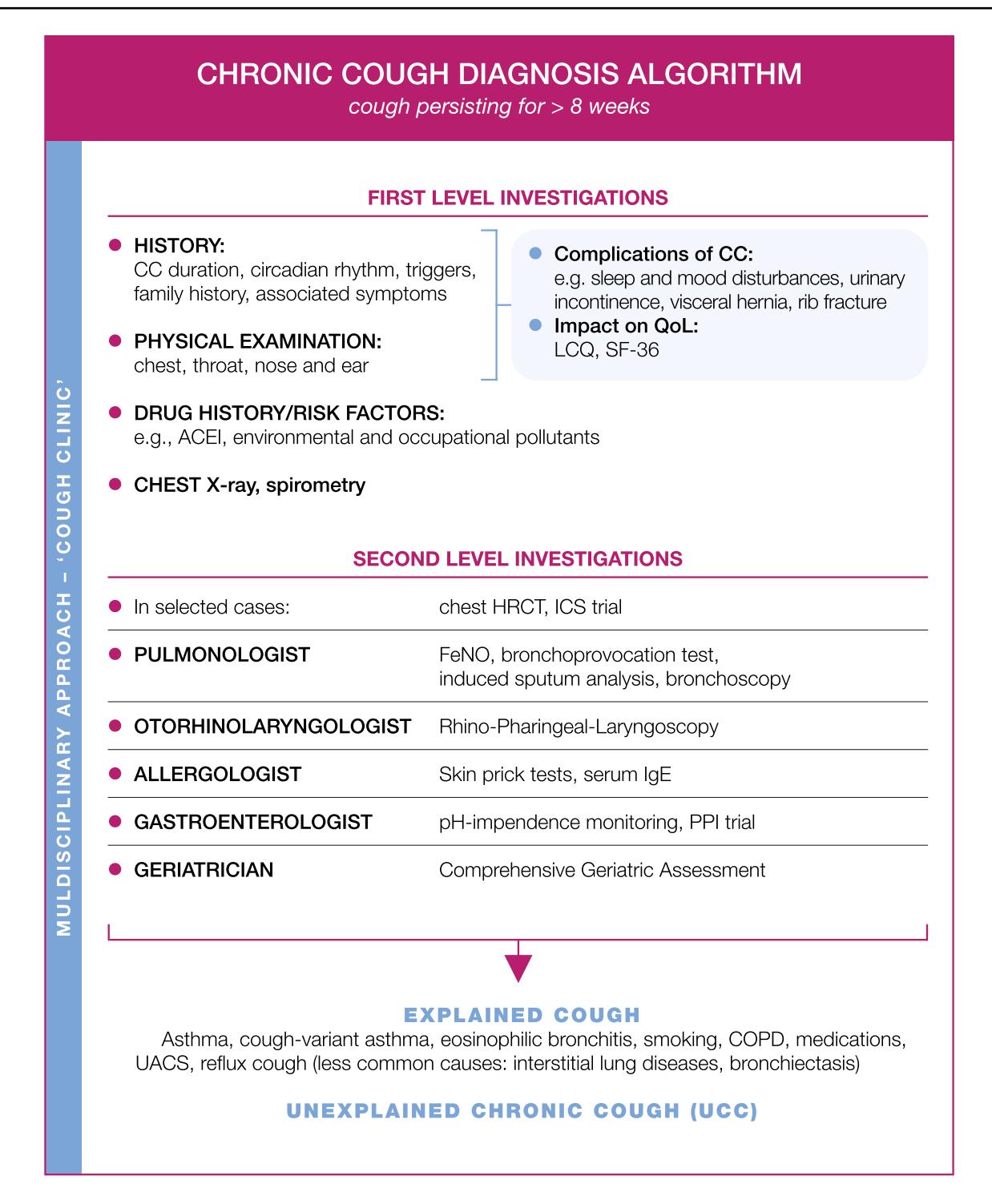
*Figure: A multidisciplinary diagnostic algorithm for chronic cough (duration > 8 weeks) structured into first and second-level investigations to identify explained or unexplained causes.*
**The following treatment algorithm categorizes chronic cough into specific and unspecific types:**
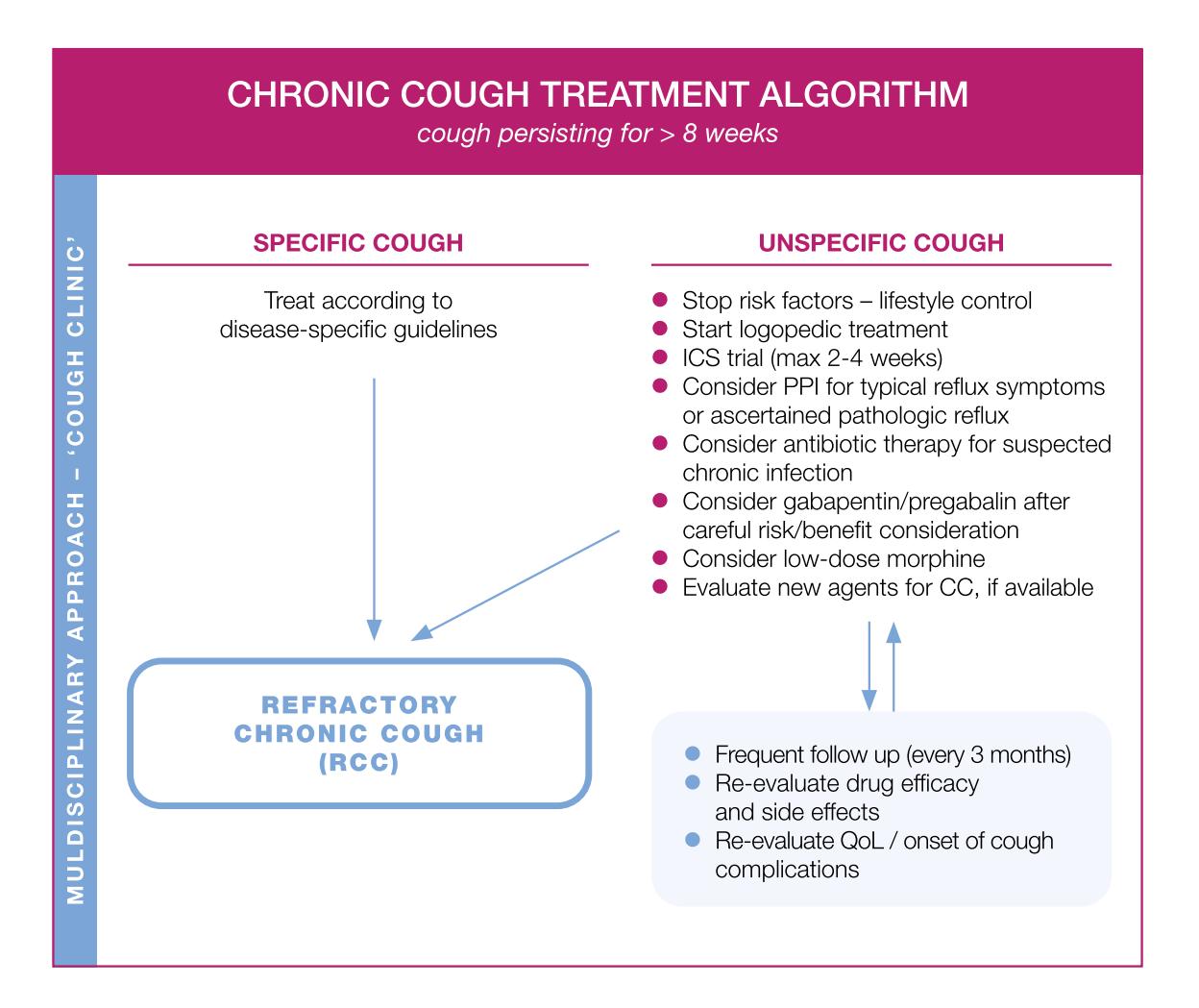
*Figure: A clinical algorithm for managing chronic cough persisting over 8 weeks, categorizing cases into specific and unspecific types and outlining treatment pathways leading to refractory chronic cough management.*
**The following diagnostic and therapeutic algorithm focuses on common etiologies and escalation to second-line assessments:**

*Figure: A diagnostic and therapeutic algorithm for managing chronic cough lasting at least 8 weeks, focusing on common etiologies and escalation to second-line assessments.*
### 5. Diagnostic Workflow Summary
The initial assessment for chronic cough should include [2][5]:
1. **Detailed history**: Duration, triggers, character (dry vs. productive), associated symptoms (nasal, wheeze, heartburn), medication history (ACE inhibitors), smoking, occupational exposures.
2. **Chest X-ray** and **spirometry** (age >6 years) as first-line investigations [2].
3. **Probability-based algorithms** guide further testing based on clinical suspicion [2].
4. **Multidisciplinary approach**: Otolaryngologists, pulmonologists, allergists, and gastroenterologists are key contributors [1][5].
---
### Further Diagnostic Suggestions (Reference Only)
To enable a more accurate assessment, if available, please consider providing:
- **Spirometry with bronchial provocation test results**: To differentiate CVA from NAEB and other causes.
- **Induced sputum eosinophil count**: To confirm or exclude NAEB.
- **24-hour esophageal pH monitoring or PPI trial response**: To evaluate GERD as a contributing factor.
- **ACE inhibitor use history**: A critical and easily reversible cause.
---
*This analysis is based on retrieved clinical guidelines and literature. Clinical judgment and individual patient context should guide final diagnostic and management decisions.*