Third-generation cephalosporins
third-generation cephalosporins?
# Third-Generation Cephalosporins: A Clinical Overview
## Definition & Classification
Third-generation cephalosporins are broad-spectrum beta-lactam antibiotics derived from 7-aminocephalosporanic acid, characterized by enhanced activity against gram-negative bacteria compared to earlier generations [8]. Key agents include **ceftriaxone**, **cefotaxime**, **cefixime**, **cefpodoxime**, **cefdinir**, and **ceftibuten** [5].
## Spectrum of Activity
Third-generation cephalosporins demonstrate activity against most *Enterobacteriaceae* and have expanded gram-negative coverage relative to first- and second-generation agents [8]. They are active against *Escherichia coli*, *Klebsiella* species, *Proteus mirabilis*, *Haemophilus influenzae*, *Enterobacter*, *Citrobacter*, *Serratia* species, and some anaerobes [8].
## Clinical Indications
Based on retrieved evidence, third-generation cephalosporins are indicated for:
- **Complicated urinary tract infections (cUTI) including pyelonephritis**: Recommended as empiric therapy in patients without sepsis (conditional recommendation, very low to moderate certainty) [1][2]
- **Febrile UTI in children**: Suggested as initial empiric therapy (2⨁◯◯◯) [7]
- **Acute bacterial meningitis**: Mainstay of empiric treatment per WHO guidelines [4]
- **Severe bacterial infections**: Meningitis, pneumonia, typhoid fever, shigellosis, leptospirosis, neurosyphilis [11]
- **Gonococcal infections**: Cervicitis, urethritis, conjunctivitis due to *Neisseria gonorrhoeae* (in combination with chlamydia treatment except in neonates), chancroid [11]
## Dosing (Ceftriaxone as Representative Agent)
| Indication | Pediatric (≥1 month) | Adult |
|------------|---------------------|-------|
| Severe bacterial infections | 50–100 mg/kg once daily (max 2 g daily) | 1–2 g once daily |
| Typhoid fever/meningitis | Up to 4 g daily | Up to 2 g once or twice daily |
*Route: IM (with lidocaine-containing solvent) or slow IV injection (3 min) / infusion (30 min)* [11]
## Resistance Considerations
A critical limitation is the rising prevalence of **extended-spectrum beta-lactamase (ESBL)-producing Enterobacterales**, which threatens the efficacy of third-generation cephalosporins [1]. Global surveillance data indicate:
- **E. coli** resistance to third-generation cephalosporins in bloodstream infections: median **44.7%** globally (IQR 17.9–70.9) in 2022 [6]
- **Klebsiella pneumoniae** resistance: median >60% from 2018–2022 [6]
- EU/EEA countries showed a 16.8% decrease in third-generation cephalosporin-resistant *E. coli* BSI incidence from 2019–2022 [6]
The following figures illustrate the global resistance landscape:
**The charts below display antimicrobial resistance percentages across various antibiotic classes:**
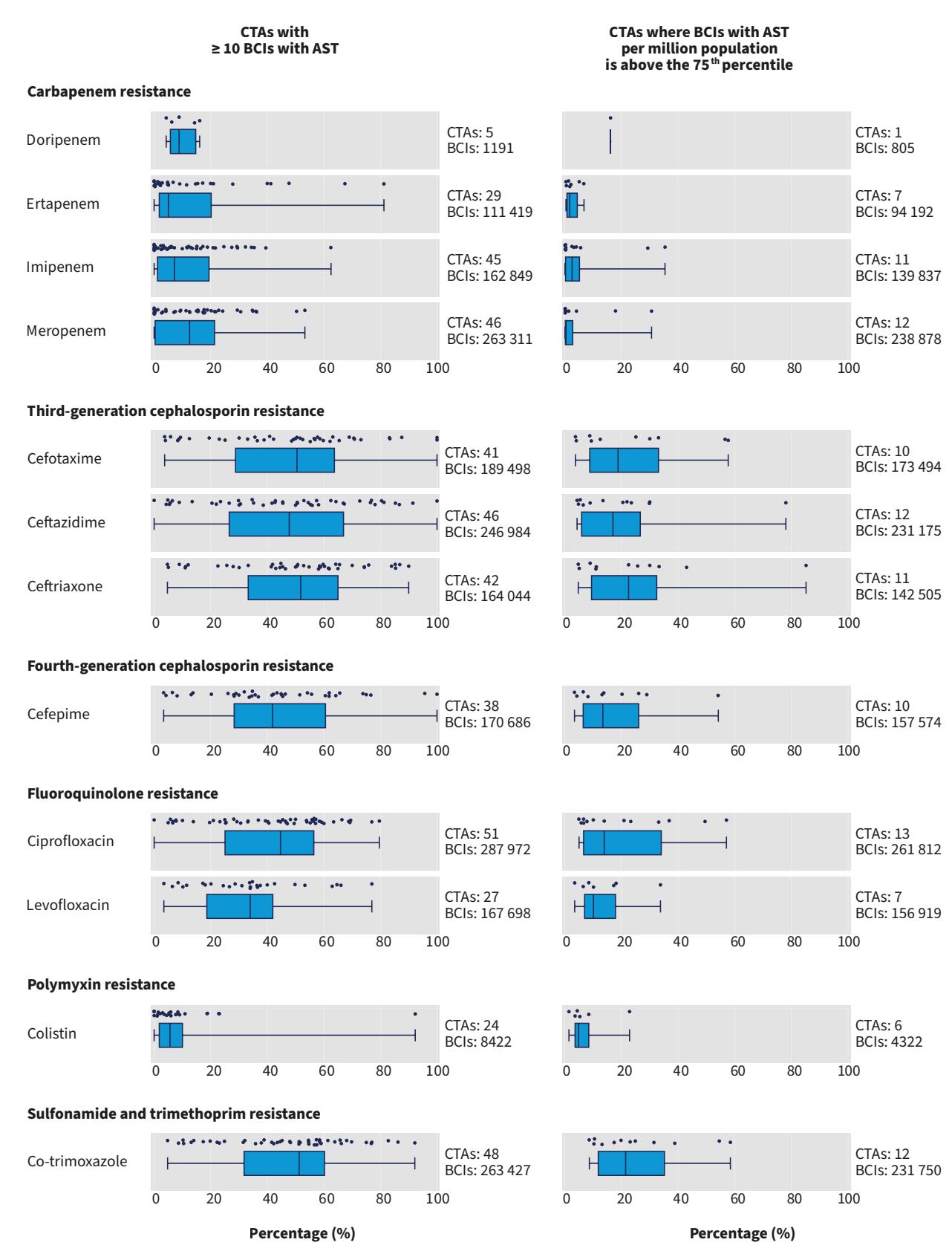
*Figure: Box plots showing significantly higher resistance rates for third-generation cephalosporins and fluoroquinolones compared to carbapenems across global surveillance data*
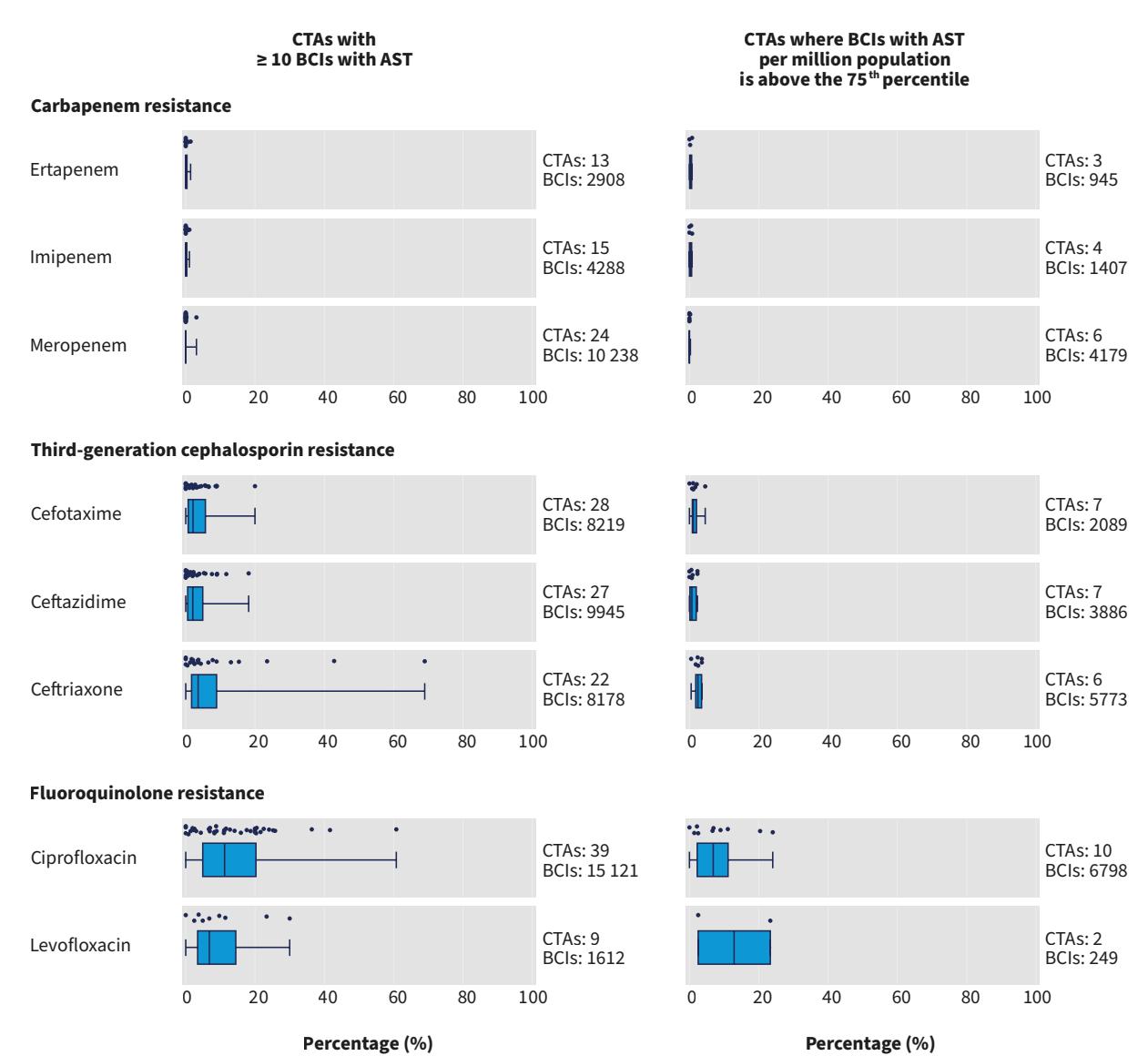
*Figure: Demonstrates low carbapenem resistance but significant and variable resistance to third-generation cephalosporins and fluoroquinolones across different clinical areas*
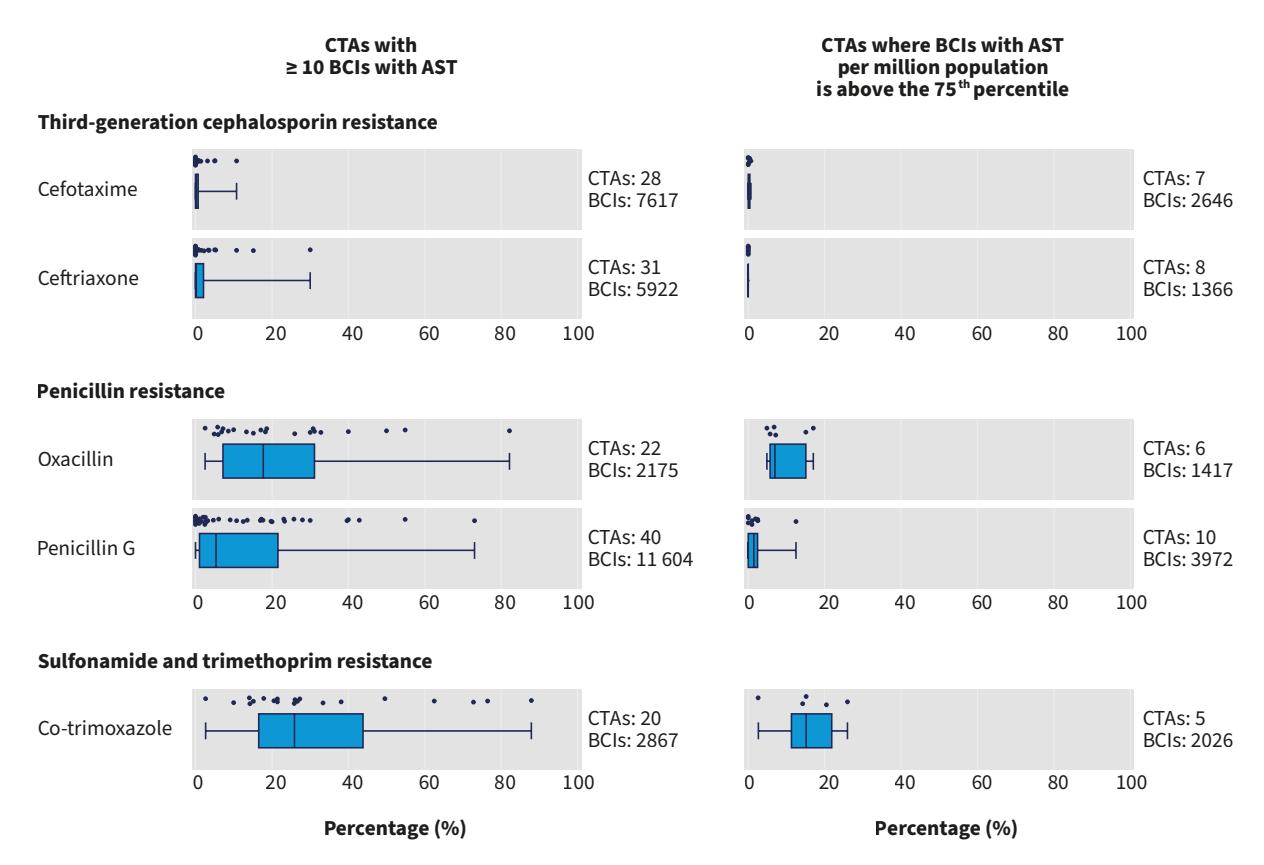
*Figure: Shows high variability in resistance for Penicillin and Co-trimoxazole compared to Cephalosporins across Clinical Trial Areas*
## Safety Profile
### Adverse Effects
- **Drug-Induced Liver Injury (DILI)**: Cephalosporins are associated with hepatotoxicity, with clinical and genetic associations documented in the Drug-Induced Liver Injury Network [5]
- Common adverse events include gastrointestinal disturbances, hypersensitivity reactions, and injection site reactions
### Contraindications
- Known hypersensitivity to cephalosporins or other beta-lactam antibiotics
- Ceftriaxone is contraindicated in neonates with hyperbilirubinemia (risk of bilirubin displacement)
## Guideline Recommendations Summary
| Condition | Recommendation | Evidence Level |
|-----------|---------------|----------------|
| cUTI without sepsis | Third-generation cephalosporins as initial option | Conditional, very low–moderate [2] |
| Febrile UTI in children | Third-generation cephalosporins or co-amoxiclav as first-line | 2⨁◯◯◯ [7] |
| Acute bacterial meningitis | Mainstay empiric therapy | WHO guideline [4] |
| Campylobacter bacteremia (HIV) | Third-generation cephalosporins NOT reliably active; carbapenems may be needed | AIII [3] |
## Critical Gaps
- **Limited evidence in special populations**: No specific data available for pregnant women, elderly, or immunocompromised individuals regarding third-generation cephalosporin efficacy in meningitis [4]
- **Local resistance patterns**: Antibiotic choice should be guided by local susceptibility data, as resistance varies significantly by region and clinical setting [7]
- **Pediatric UTI evidence**: Low-certainty evidence showing no difference between third-generation cephalosporins and other antibiotics for persistent bacteriuria or recurrence [7]
## Conclusion
Third-generation cephalosporins remain a cornerstone for empiric therapy of serious gram-negative infections including cUTI, meningitis, and febrile UTI in children, though their utility is increasingly constrained by ESBL-mediated resistance, necessitating local susceptibility-guided selection and consideration of carbapenems in severely ill or high-resistance settings.
---
*This content is AI-generated based on retrieved literature and is intended for clinical reference only. Clinicians should verify against official drug labeling and apply individual patient judgment when making treatment decisions.*
Which one is better for postpartum use?
## Third-Generation Cephalosporins for Postpartum Use: Comparative Analysis
### Conclusion-First
For postpartum endometritis, **clindamycin plus gentamicin remains the gold standard regimen**, with third-generation cephalosporins showing inferior efficacy as monotherapy due to inadequate anaerobic coverage, though they may be considered in specific contexts such as surgical prophylaxis or mild infections.
---
## Clinical Evidence & Efficacy
### Postpartum Endometritis
The combination of **clindamycin 900 mg IV q8h plus gentamicin 4 mg/kg IV once daily** is the established first-line regimen for endometritis following cesarean delivery [8]. Meta-analysis demonstrates that only **20 women need to be treated with clindamycin/gentamicin to prevent one treatment failure** compared to other regimens including cephalosporins [8].
| Regimen | Efficacy | Key Limitation |
|---------|----------|----------------|
| Clindamycin + gentamicin | Gold standard; fewer failures with once-daily gentamicin dosing [8] | Requires monitoring of gentamicin trough levels |
| Third-generation cephalosporins (monotherapy) | Inferior to clindamycin/gentamicin | Poor activity against penicillin-resistant anaerobes (e.g., *Bacteroides fragilis* group) [8] |
| Metronidazole + penicillin + aminoglycoside | Appropriate alternative for post-cesarean infection [8] | Triple-drug regimen |
| Clindamycin + aztreonam | Appropriate alternative for penicillin-allergic patients [8] | Higher cost |
**Critical caveat**: Small studies comparing single broad-spectrum agents (including second- or third-generation cephalosporins) with clindamycin/gentamicin show **equal efficacy**, but meta-analysis confirms the superiority of the clindamycin/gentamicin combination [8].
### Prophylaxis at Cesarean Section
Third-generation cephalosporins (specifically **ceftriaxone 1–2 g IV**) are effective for surgical prophylaxis:
- A systematic review of 10 RCTs (n=5,041) comparing first-generation (cefazolin) vs. third-generation cephalosporins (ceftriaxone) for cesarean section prophylaxis found:
- **Maternal infection**: Reduced with prophylaxis after cord clamping (RR 0.57, 95% CI 0.45–0.72) [5]
- **Endometritis**: Reduced (RR 0.54, 95% CI 0.36–0.79) [5]
- **Surgical wound infection**: Reduced (RR 0.59, 95% CI 0.44–0.81) [5]
- **Neonatal sepsis**: No significant difference (RR 0.76, 95% CI 0.51–1.13) [5]
Another RCT (n=200) compared **cloxacillin + gentamicin** (postoperative, 5 days) vs. **cefotaxime 1 g IV single dose** (after cord clamping) and found comparable efficacy for postpartum infection prevention [6].
### Neonatal Gonococcal Conjunctivitis
For gonococcal conjunctivitis in neonates, **cefotaxime 50 mg/kg IV/IM once** plus azithromycin is recommended (AIII) [4]. Ceftriaxone is an alternative only in neonates **without risk for hyperbilirubinemia or IV calcium-drug interactions** [1][4].
---
## Safety Profile
### Ceftriaxone-Specific Neonatal Contraindications
| Contraindication | Detail | Source |
|-----------------|--------|--------|
| Hyperbilirubinemia | Ceftriaxone displaces albumin-bound bilirubin → increased free bilirubin → kernicterus risk | [1] |
| Preterm/acidotic neonates | Avoid in any at-risk neonate, especially unstable, acidotic, preterm, or up to postmenstrual age 41 weeks | [1] |
| IV calcium co-administration (neonates <28 days) | Fatal ceftriaxone-calcium precipitates in lungs and kidneys | [1][4] |
**Recommendation**: For neonates with hyperbilirubinemia or requiring IV calcium, **cefotaxime or cefepime is preferred** [1].
### Postpartum Women
- Third-generation cephalosporins are generally well-tolerated in postpartum women
- No specific safety signals unique to the postpartum period have been identified in retrieved evidence
- Changes in endometrial flora following cephalosporin prophylaxis may increase enterococcal infections [8]
---
## Guideline Recommendations
| Indication | Recommended Regimen | Evidence Level |
|------------|-------------------|----------------|
| Post-cesarean endometritis | Clindamycin 900 mg IV q8h + gentamicin 4 mg/kg IV once daily | Gold standard [8] |
| Post-cesarean endometritis (after cephalosporin prophylaxis) | Add ampicillin or vancomycin if no response to clindamycin/gentamicin within 48h | Pragmatic recommendation [8] |
| Cesarean section prophylaxis | Cefazolin 1–2 g IV (first-line); ceftriaxone 1–2 g IV (alternative) | Systematic review evidence [5] |
| Neonatal gonococcal conjunctivitis | Cefotaxime 50 mg/kg IV/IM once + azithromycin | AIII [4] |
---
## Critical Gaps
- **No direct head-to-head RCTs** comparing third-generation cephalosporins specifically against clindamycin/gentamicin for postpartum endometritis treatment in the retrieved evidence
- **No evidence-based recommendations** exist for treating endometritis after cephalosporin prophylaxis — only 54% of women responded to clindamycin/gentamicin within 48 hours in one study [8]
- **Pharmacokinetic data in postpartum women** is limited; gentamicin dosing requires adjustment for increased renal clearance, volume of distribution, and obesity [8]
---
## Conclusion
Third-generation cephalosporins are **not superior** to clindamycin/gentamicin for treatment of established postpartum endometritis and should not be used as monotherapy due to inadequate anaerobic coverage. Their primary role in the postpartum setting is **surgical prophylaxis** at cesarean section, where ceftriaxone 1–2 g IV after cord clamping is an effective alternative to cefazolin. For neonatal infections, cefotaxime is preferred over ceftriaxone due to safety concerns with hyperbilirubinemia and calcium interactions.
---
*This content is AI-generated based on retrieved literature and is intended for clinical reference only. Clinicians should verify against official drug labeling and apply individual patient judgment when making treatment decisions.*