Persistent Cough Differential Diagnosis
What conditions need to be considered in the differential diagnosis of a persistent cough lasting 8 weeks in an adult?
**Conclusion:** In an adult with a cough lasting 8 weeks (chronic cough), the differential diagnosis is broad, but the most common causes are upper airway cough syndrome (UACS), asthma/cough variant asthma, and gastroesophageal reflux disease (GERD), with additional consideration of eosinophilic bronchitis, ACE inhibitor use, and less common but serious conditions such as COPD, bronchiectasis, and pulmonary embolism [1][5][8].
---
## Differential Diagnosis of Chronic Cough (>8 weeks) in Adults
### 1. Definition and Initial Assessment
Chronic cough is defined as a cough lasting **8 weeks or longer** in adults [4][5][8]. The initial assessment should include a detailed history, physical examination, chest radiography, and spirometry (with post-bronchodilator testing) to identify red flags and guide further evaluation [3][5].
**The following infographic categorizes the various conditions contributing to chronic cough in adults:**

*Figure: Categorization of systemic, upper, middle, and lower airway conditions contributing to chronic cough in adult patients*
---
### 2. Most Common Causes (The "Big Three")
In nonsmoking adults not on an ACE inhibitor, three conditions account for the majority of chronic cough cases [5][8]:
| Condition | Key Features | Diagnostic Approach |
|-----------|-------------|---------------------|
| **Upper Airway Cough Syndrome (UACS)** | Sensation of postnasal drip, throat clearing, nasal/sinus congestion; may be asymptomatic in 20% of cases [8] | History, ENT examination, therapeutic trial with antihistamine/decongestant or intranasal steroids [8] |
| **Asthma / Cough Variant Asthma (CVA)** | Episodic wheeze, dyspnea, chest tightness; CVA presents with cough alone, normal spirometry, positive bronchial provocation [3] | Spirometry with bronchodilator response, bronchial provocation testing; response to bronchodilators is specific to CVA [3][7] |
| **GERD** | Heartburn, regurgitation; may cause cough without typical symptoms [5] | 24-hour esophageal pH monitoring, empirical PPI trial [5][6] |
**Eosinophilic bronchitis** (non-asthmatic) accounts for approximately **10%** of chronic cough cases and is characterized by increased lower airway eosinophils, normal spirometry, and negative bronchial provocation [3][5].
---
### 3. Additional Causes by Age Group
The differential diagnosis varies with age. For adults, the following conditions should be considered [1]:
#### Adults 12–39 years
- **Cough hypersensitivity / Inducible laryngeal obstruction**: Cough or dyspnea triggered by smoke, strong smells, or food; stridor [1]
- **Hyperventilation / Dysfunctional breathing**: Dizziness, paresthesia, sighing [1]
- **Bronchiectasis / Protracted bacterial bronchitis**: Productive cough, recurrent chest infections [1]
- **Cystic fibrosis**: Excessive cough, mucus production, gastrointestinal symptoms [1]
- **Alpha-1 antitrypsin deficiency**: Shortness of breath, family history of early emphysema [1]
- **Inhaled foreign body**: Sudden onset of symptoms [1]
#### Adults 40+ years
- **COPD**: Cough, sputum, dyspnea on exertion, smoking or noxious exposure [1]
- **Cardiac failure**: Dyspnea with exertion, nocturnal symptoms, ankle edema [1]
- **Medication-related cough (ACE inhibitors)**: Treatment with ACE inhibitor [1][5]
- **Parenchymal lung disease**: Dyspnea with exertion, non-productive cough, finger clubbing [1]
- **Pulmonary embolism**: Sudden onset of dyspnea, chest pain [1]
- **Central airway obstruction**: Dyspnea unresponsive to bronchodilators [1]
#### All Ages
- **Tuberculosis**: Chronic cough, hemoptysis, dyspnea, fatigue, fever, night sweats, weight loss [1]
- **Pertussis**: Prolonged paroxysms of coughing, sometimes stridor [1]
---
### 4. Diagnostic Algorithm
**The following flowchart illustrates the systematic diagnostic and management pathway for adults with chronic cough:**

*Figure: Systematic diagnostic and management pathway for adults presenting with chronic cough lasting more than 8 weeks*
**The following flowchart demonstrates the stepwise approach through diagnostic testing and empirical therapeutic trials:**
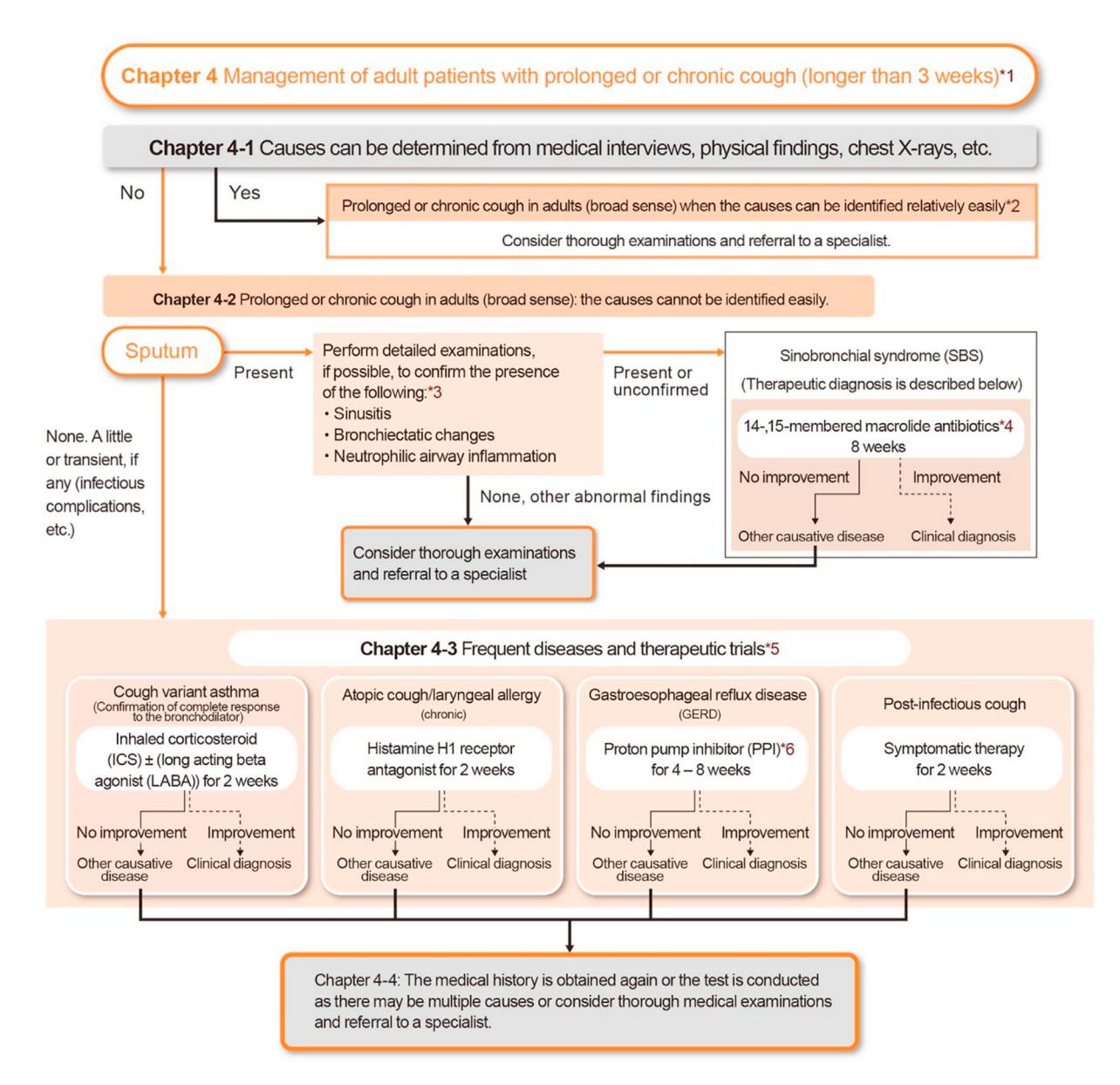
*Figure: Clinical flowchart for systematic management of adult patients with prolonged or chronic cough through diagnostic steps and empirical therapeutic trials*
**The following graph illustrates the classification of cough by duration and shifting probability of etiologies over time:**

*Figure: Classification of cough by duration and the shifting probability between infectious and non-infectious etiologies over time*
---
### 5. Red Flags Requiring Urgent Evaluation
The following findings warrant immediate investigation for serious underlying pathology [1][3]:
- **Hemoptysis**
- **Fever, night sweats, weight loss** (suggestive of tuberculosis or malignancy)
- **Sudden onset of dyspnea with chest pain** (pulmonary embolism)
- **Finger clubbing** (parenchymal lung disease)
- **Unilateral wheeze** (foreign body or central airway obstruction)
- **Dyspnea unresponsive to bronchodilators** (central airway obstruction)
---
### 6. Diagnostic Pitfalls
- **History alone is of limited value**: A prospective study found that the character and timing of cough are of little value in determining etiology [8].
- **Multiple conditions co-exist**: Many common causes (UACS, asthma, GERD) frequently occur together, and treatment may need to address several simultaneously [3][5].
- **Refractory/Unresolved cough**: Chronic cough frequently persists despite thorough workup and empirical therapy, termed refractory or unexplained chronic cough (RCC/UCC) [2].
- **ACE inhibitor cough**: Should be excluded early, as it is a common reversible cause [1][5].
---
### 7. Recommended Diagnostic Workflow
| Step | Investigation | Purpose |
|------|--------------|---------|
| **1. Initial Assessment** | History, physical exam, red flag screening | Identify alarm symptoms, medication history (ACE inhibitors), smoking status [3][5] |
| **2. Baseline Testing** | Chest X-ray, spirometry with post-bronchodilator | Exclude parenchymal disease, assess airflow obstruction [3][5] |
| **3. Targeted Evaluation** | Bronchial provocation testing, induced sputum eosinophils, 24h pH monitoring, sinus CT | Confirm asthma/CVA, eosinophilic bronchitis, GERD, sinusitis [3][6] |
| **4. Empirical Trials** | Antihistamine/decongestant or nasal steroids (UACS), inhaled corticosteroids (asthma), PPI (GERD) | Diagnostic/therapeutic trials per ACCP recommendations [8] |
---
### Further Diagnostic Suggestions (Reference Only)
To enable a more accurate assessment, if available, please consider providing:
- **Smoking history and occupational exposures**: Critical for distinguishing COPD, which is a leading cause in adults 40+ years [1]
- **Medication history (specifically ACE inhibitors)**: A common reversible cause that should be excluded before extensive workup [1][5]
- **Chest imaging results**: Chest X-ray or CT findings to exclude parenchymal lung disease, bronchiectasis, or malignancy [3][5]
---
*This content is AI-generated based on retrieved literature and is intended for clinical reference only. Please verify against original sources and apply individual patient judgment.*