Prostate Cancer Symptoms Survival Rate
prostate cancer symptoms and prostate cancer survival rate
## Prostate Cancer: Clinical Presentation and Survival Outcomes
### Clinical Presentation
**Localized Disease**
Most cases of early prostate cancer are asymptomatic. Many patients present with unrelated urologic issues that prompt a PSA test, including urinary symptoms such as frequency, nocturia, hesitancy, and incomplete voiding, or sexual side effects like erectile dysfunction [4].
**Advanced or Metastatic Disease**
Advanced or metastatic disease can present with pain, typically back or bone pain. Very advanced disease can lead to metastatic spinal cord compression with radiating back or leg pain, leg weakness, numbness, tingling, paralysis, or incontinence [4].
---
### Survival Rates
**Overall Survival**
- The 5-year relative survival rate for prostate cancer across all stages combined is **97%** [1][7].
- The 5-year relative survival for localized prostate cancer exceeds **99%** [8].
- Over the past four decades, the 5-year survival rate has increased from **68% to >95%**, with localized disease approaching **100%** [4].
**Metastatic Disease**
- The 5-year relative survival for those with distant metastases falls precipitously to **32.3%** [3].
- Other estimates place metastatic/castration-resistant disease survival at **30–40%** [8].
- Patients with metastatic castration-resistant prostate cancer (mCRPC) still have a dismal prognosis despite treatment advances [3].
**Mortality Trends**
- Prostate cancer is estimated to account for **11% of male cancer deaths** in the United States in 2025, with approximately **35,770 deaths** [1].
- The age-adjusted death rate declined by **52% from 1993 to 2017**, but has stabilized in recent years, with a **0.5% annual decrease from 2012 through 2022** [1].
- The relatively low death rate reflects increased public awareness with earlier detection and treatment, though it is complicated by screening-related lead-time bias and detection of indolent cancers [1].
**The following chart illustrates 5-year relative survival rates across cancer types, highlighting the favorable prognosis for localized prostate cancer:**
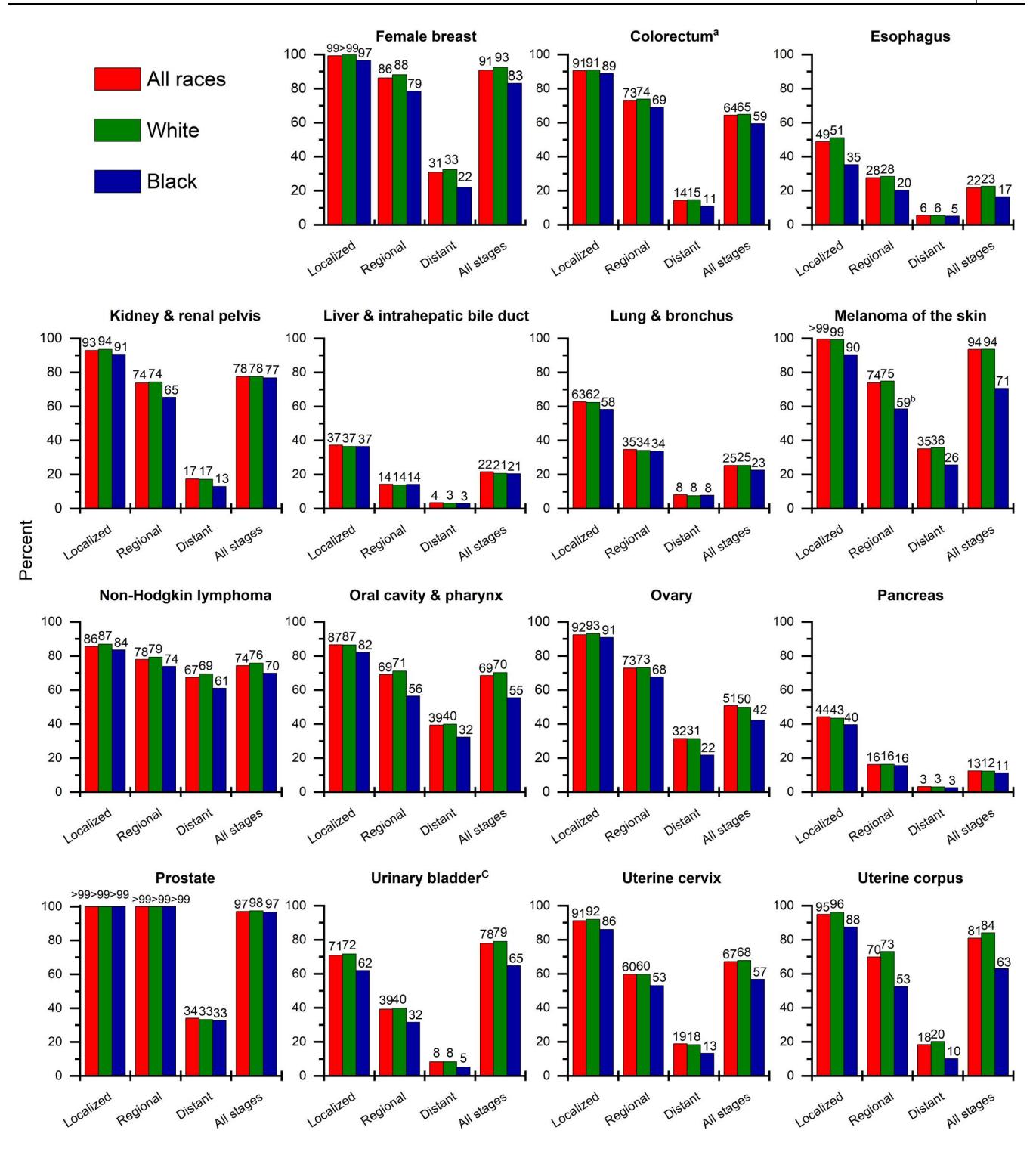
*Figure: 5-year relative survival rates for various cancers, demonstrating significantly better outcomes for localized stages and revealing persistent racial disparities, particularly lower survival rates for Black patients*
---
### Survival in Special Populations
**BRCA2 Carriers**
A retrospective analysis (1998–2010) showed a **12-year prostate cancer survival rate of 61.8%** in BRCA2 carriers compared to **94.3%** in participants without BRCA2 pathogenic/likely pathogenic variants [6]. The IMPACT study's 3-year prospective PSA-only screening protocol identified that BRCA2 carriers had higher rates of prostate cancer, as well as more clinically significant disease, compared to BRCA1 and BRCA2 non-carriers [6].
**Active Surveillance**
For intermediate-risk prostate cancer managed with active surveillance, cancer-specific survival rates were:
- **100%** at 5 years
- **96.1%–100%** at 10 years
- **89%–100%** at 15 years
In long-term follow-up, cancer deaths were observed in up to **11%** of cases, with some reports suggesting the 10-year cancer-specific mortality rate for active surveillance is higher than that of surgery or radiotherapy. However, since all studies were single-arm observational or retrospective cohort studies, the strength of evidence was rated **C** [5].
---
### Quality of Life Considerations
More than **one in three** individuals treated for prostate cancer experience long-term decrements in quality of life, with significant impact on physical, mental, metabolic, and sexual health. These include long-term toxicities from radical treatment and ongoing adverse effects of treatment for metastatic disease [4].
Standardized patient-reported outcome measures (PROMs) for prostate cancer-specific quality of life include [2]:
| Instrument | Domains Assessed |
|------------|------------------|
| EORTC QLQ-C30 | Physical, role, cognitive, emotional, social function; fatigue, pain, nausea/vomiting; global QoL |
| EORTC QLQ-PR25 | Urinary, bowel, treatment-related symptoms; sexual activity and function |
| FACT-P | Prostate-related symptoms (12 items); combinable with FACT-G |
| EPIC / EPIC-26 | Urinary, bowel, sexual, hormonal symptoms |
| UCLA PCI | Urinary, bowel, sexual domains |
| PCQoL | Urinary, sexual, bowel domains; anxiety scale |
---
### Critical Gaps
The retrieved evidence does not provide stage-specific survival data stratified by treatment modality (surgery vs. radiotherapy vs. systemic therapy) for localized disease, nor does it address survival outcomes for the newly approved AR-signaling inhibitors or PARP inhibitors in the metastatic setting beyond the general statement that current regimens prolong life expectancy by an average of **2–3 years** [8].
---
### Conclusion
Prostate cancer carries an excellent overall prognosis (97% 5-year relative survival), but survival drops dramatically to approximately 30–40% once metastasis or castration resistance develops, underscoring the importance of early detection and the ongoing challenge of managing advanced disease.
---
*This content is AI-generated based on retrieved literature and is intended for clinical reference only. Please verify against primary sources and apply individual patient judgment.*