Statin Muscle Symptoms CK Elevation
Statin-associated muscle symptoms pathophysiology mechanisms CK elevation without myalgia
## Statin-Associated Muscle Symptoms: Pathophysiology, Mechanisms, and CK Elevation Without Myalgia
### Pathophysiology and Mechanisms
The exact molecular mechanism of statin-associated muscle symptoms (SAMS) remains incompletely understood, with evidence supporting both direct and indirect myotoxic effects on skeletal muscle [8]. The prevailing mechanistic hypotheses include:
- **Isoprenoid depletion**: Inhibition of HMG-CoA reductase in skeletal muscle disrupts the synthesis of isoprenoids (e.g., farnesyl pyrophosphate, geranylgeranyl pyrophosphate), which are essential for the post-translational modification (prenylation) of small GTP-binding proteins (e.g., Rho, Rac, Cdc42). Impaired prenylation of these proteins may disrupt cellular signaling, cytoskeletal integrity, and mitochondrial function, leading to myocyte injury [8].
- **Mitochondrial dysfunction**: Statins may impair mitochondrial electron transport chain function, reduce coenzyme Q10 (ubiquinone) levels, and promote mitochondrial permeability transition, resulting in energy depletion and oxidative stress within skeletal myocytes.
- **Calcium homeostasis disruption**: Statin-induced alterations in sarcoplasmic reticulum calcium handling may contribute to myocyte dysfunction and necrosis.
- **Genetic susceptibility**: Variants in the *SLCO1B1* gene, which encodes the organic anion transporting polypeptide OATP1B1 responsible for hepatic statin uptake, significantly increase systemic statin exposure and myopathy risk, particularly for simvastatin [8].
### Clinical Spectrum of Statin-Associated Muscle Symptoms
SAMS encompasses a spectrum of clinical presentations [9]:
| Category | Description | CK Level | Clinical Course |
|----------|-------------|----------|-----------------|
| **Myalgia** | Muscle pain, soreness, aches, cramps, or fatigue without CK elevation | Normal | Resolves with statin discontinuation |
| **Myopathy** | Unexplained muscle pain or weakness with CK >10× ULN | Elevated >10× ULN | Resolves with statin discontinuation |
| **Rhabdomyolysis** | Severe muscle injury with CK >10× ULN, myoglobinuria, risk of acute renal failure | Markedly elevated >10× ULN | Resolves with statin discontinuation |
| **Immune-mediated necrotizing myopathy (IMNM)** | Severe progressive myopathy with weakness, anti-HMGCR antibodies | Elevated | Progresses despite statin discontinuation; requires immunosuppression |
### CK Elevation Without Myalgia (Asymptomatic HyperCKemia)
Asymptomatic elevation of serum CK (elevated CK without muscle pain or weakness) occurs in approximately **1% of patients taking statins** [9]. This finding presents a common clinical dilemma.
**Key considerations**:
- **Prevalence**: Asymptomatic hyperCKemia is more common than symptomatic myopathy. The annual incidence of myopathy (CK >10× ULN with symptoms) is approximately **1 case per 10,000 patients treated**, whereas asymptomatic CK elevations are substantially more frequent [2].
- **Clinical significance**: In most cases, asymptomatic CK elevation does not require statin discontinuation. The 2026 ACC/AHA Guideline notes that there are **no absolute CK levels to guide therapy** in the absence of symptoms [1].
- **Differential diagnosis**: When evaluating isolated CK elevation, consider:
- **Strenuous physical activity** — the most common cause
- **Hypothyroidism** — a reversible cause that increases SAMS risk [1][5]
- **Idiopathic inflammatory myopathy**
- **Familial muscle diseases**
- **Macro-CK** — a complex of CK with immunoglobulin, resulting in reduced renal clearance [5]
- **Ethnic and sex-based variation**: Black men have the highest baseline CK levels; further evaluation may not be needed unless CK >1000 IU/L, whereas in White women, CK >300 IU/L may warrant investigation [5]
- **Management approach**: For asymptomatic CK elevation without weakness, the 2026 ACC/AHA Guideline recommends evaluation for secondary causes (Table 24) including hypothyroidism, diabetes, chronic kidney disease, and vigorous exercise [1]. Statin continuation is generally appropriate with monitoring.
### Risk Factors for SAMS
The 2026 ACC/AHA Guideline identifies the following factors associated with increased risk for statin-attributed muscle symptoms [1]:
- Age ≥65 years
- Low body mass index
- Female sex
- Hypothyroidism
- Diabetes
- Chronic kidney or liver disease
- Alcohol consumption
- Vigorous exercise
- High-dose statin therapy (strongest independent predictor; approximately 6-fold higher risk vs. lower doses) [8]
- Drug interactions affecting statin metabolism (e.g., CYP3A4 inhibitors for simvastatin, atorvastatin)
- *SLCO1B1* gene variants
### Temporal Pattern and Diagnosis
SAMS typically presents as **new-onset bilateral, symmetrical, proximal muscle pain or weakness** occurring within weeks after statin initiation or dose escalation. Symptoms generally resolve within 1–2 weeks after discontinuation and may recur upon reinitiation [1][6]. The **Statin-Associated Muscle Symptoms-Clinical Index (SAMS-CI)** is a validated tool to determine the likelihood that statin therapy is the cause of muscle symptoms [5].
**The following flowchart illustrates the clinical management algorithm for statin-associated muscle symptoms:**
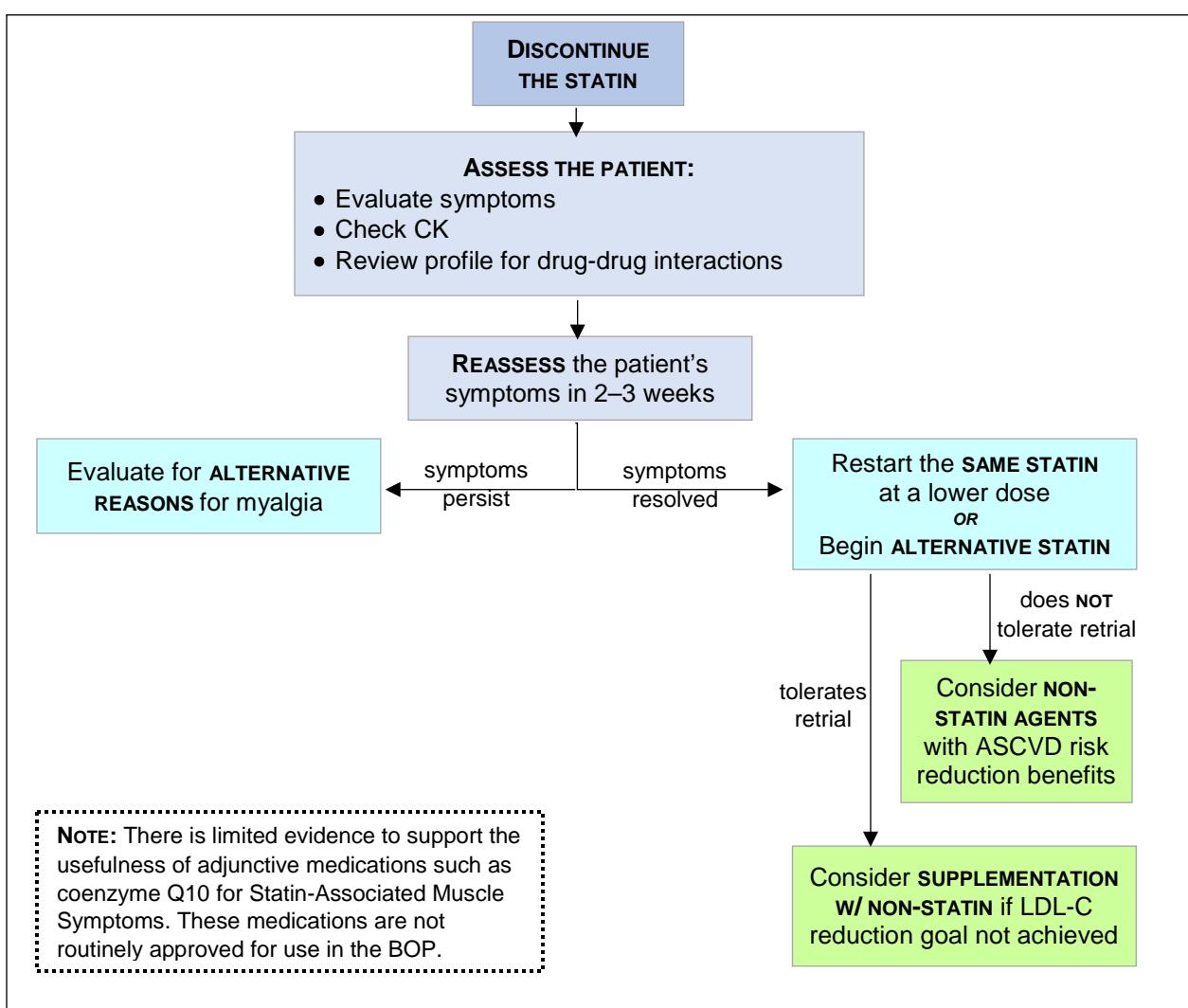
*Figure: A clinical flowchart detailing the step-by-step management of patients experiencing statin-associated muscle symptoms, from discontinuation to retrial or alternative therapy*
### Key Clinical Points
- The **nocebo/drucebo effect** is well-documented: in blinded N-of-1 trials, approximately 60% of patients reporting statin intolerance experienced similar muscle pain with placebo [2]. This underscores the importance of objective evaluation.
- For patients with severe myalgia or weakness, **objective clinical measures of muscle strength** and CK measurement are recommended to assess severity [1].
- In the great majority of patients, a well-tolerated regimen can be devised through dose adjustment, less-than-daily dosing of long-acting statins, or addition of nonstatin therapies (ezetimibe, PCSK9 monoclonal antibodies, bempedoic acid) [1].
---
*This content is AI-generated based on retrieved literature and is intended for clinical reference only. Clinicians should verify information against official drug labeling and apply individual patient judgment in clinical decision-making.*