Rotator Cuff Rehabilitation
Rehabilitation after rotator cuff tendon injury
## Rehabilitation After Rotator Cuff Tendon Injury
Rehabilitation following rotator cuff injury—whether managed conservatively or surgically—requires a phased, individualized approach that balances tissue protection with the prevention of stiffness and functional decline. The evidence base supports structured protocols that progress through distinct stages of healing.
---
## Conservative (Non-Operative) Rehabilitation
For most rotator cuff injuries, including partial-thickness tears and tendinopathy, conservative management is the initial standard of care [6].
### Core Principles
- **Active rehabilitation is first-line**: Clinicians should prescribe or recommend an active rehabilitation exercise program, which may include motor control and/or resistance training exercises with various loads, as an initial treatment to reduce pain and disability in adults with rotator cuff tendinopathy [Grade B][5].
- **Patient education is foundational**: Provide patient-centered, individualized education on the condition, pain management options, activity modification, and self-management, accounting for health literacy, personal beliefs, goals, and psychosocial factors [Grade C][5].
- **Physiotherapy duration**: Rotator cuff and scapular stabilizer strengthening over **3–6 months** is often beneficial [6].
### Adjunctive Modalities
| Modality | Recommendation | Evidence Grade |
|----------|---------------|----------------|
| Manual therapy (soft tissue, joint mobilization) | May be used alone or with exercise for short-term pain reduction | Grade D [5] |
| Taping (in addition to active rehab) | May reduce pain in the short term | Grade D [5] |
| Acupuncture | May be recommended alongside active rehabilitation to reduce pain and disability | [5][Figure 1] |
| Laser therapy (calcific tendinopathy) | May reduce pain and disability | Grade C [5] |
| Extracorporeal shock wave (non-calcific) | **Should not** be used to reduce pain and disability | Grade C [5] |
| Therapeutic ultrasound | **Should not** be used (calcific or non-calcific) | Grade C [5] |
**The following illustrates the clinical recommendation regarding acupuncture as an adjunct to active rehabilitation:**
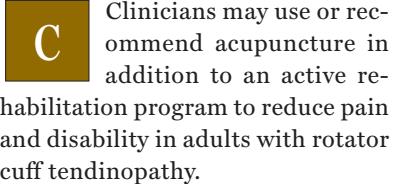
*Figure: Clinical recommendation that acupuncture may be used alongside active rehabilitation to reduce pain and disability in adults with rotator cuff tendinopathy*
**The following decision tree outlines the evidence-based management algorithm for rotator cuff tendinopathy:**

*Figure: Clinical decision tree for managing rotator cuff tendinopathy, outlining nonsurgical interventions, reassessment timelines, and specialist referral criteria*
---
## Postoperative Rehabilitation
### Phase 1: Immobilization and Protection (Weeks 0–6)
**Immobilization Duration:**
- **Small-to-medium tears**: Consider immobilizing for a **maximum of 3 weeks** after surgical repair of an isolated small-to-medium supraspinatus tendon rupture; patients benefit from early mobilization [4].
- **Large tears**: A systematic review subgroup analysis reported **significantly more re-tears after early mobilization** in large rotator cuff tears; longer protection is warranted [4].
- **Massive irreparable tears (SCR)**: Strict protection with an abduction brace for **8 weeks** is recommended [1].
**During this phase:**
- Elbow, wrist, and hand exercises are permitted to reduce edema [1].
- Pendulum exercises initiated at **2 weeks** [1].
- Passive forward flexion and external rotation introduced between **4–6 weeks** [1][18].
- **Core principle**: Protect the graft/repair from tensile forces generated by active muscle contraction [1].
### Phase 2: Active-Assisted and Early Active Motion (Weeks 6–12)
- Active-assisted range of motion begins after brace removal (typically 6 weeks) [15].
- Active movements and resumption of light work are recommended at **7–12 weeks** [12].
- Active-assisted and strengthening exercises are deferred until **8–12 weeks** to allow initial graft incorporation [1].
- At **8–12 weeks**, muscle strengthening exercises are permitted and shoulder activity gradually returns to normal [15].
### Phase 3: Strengthening and Functional Recovery (Weeks 12+)
- Progressive functional recovery, including physical activities and sports, is achieved from **13 weeks onward** [12].
- Neuromuscular adaptation and muscle strengthening continue through **12–24 months** postoperatively [3].
- Long-term follow-up and persistent rehabilitation are essential for achieving a final, stable outcome [3].
---
## Rehabilitation Protocol Comparison
| Parameter | Small-Medium Tears | Large Tears | Massive Irreparable (SCR) |
|-----------|-------------------|-------------|---------------------------|
| Immobilization | ≤3 weeks [4] | Extended (early motion increases re-tear risk) [4] | 8 weeks abduction brace [1] |
| Pendulum exercises | Early | Early | 2 weeks [1] |
| Passive ROM | 4–6 weeks [18] | 4–6 weeks | 4–6 weeks [1] |
| Active-assisted | 6 weeks [15] | 6–8 weeks | 8–12 weeks [1] |
| Strengthening | 8–12 weeks [15][18] | 8–12 weeks | After 12 weeks [1] |
---
## Special Populations
### Wheelchair-Dependent Patients
- Postoperative protocols vary widely with no consensus [9].
- PROM only for **6 weeks** before resuming manual wheelchair propulsion is a common approach [9].
- High repair failure rates (**12–33%**) are reported, attributed to the high demand placed on shoulders and difficulty adhering to protocols with single upper extremity function [9].
- Despite structural failure, functional scores (ASES, Constant) still show significant improvement [9].
### Older Athletes
- Rehabilitation should combine stretching and strengthening to restore ROM, reduce pain, maintain stability, and prevent further injury [19].
- **Acute phase**: Cryotherapy, electrical stimulation, isometric and closed-chain exercises within pain-free ROM [19].
- **Recovery phase**: Joint mobilization, posterior capsule stretching (sleeper stretches, cross-arm), progressive strengthening [19].
- **Functional phase**: Full kinetic chain training, sports-specific exercises, core and lower extremity strengthening [19].
---
## Digital and Home-Based Rehabilitation
- A 12-week program consisting of three phases (on-brace: 0–6 weeks; off-brace: 6–9 weeks; active mobilization: 9–12 weeks) is an established framework [12].
- Home-based exercise with 3–5 sets of 10 repetitions per day, guided by a brochure or digital healthcare system, is effective [12].
- Telerehabilitation shows **no significant difference in functional outcomes** compared to face-to-face rehabilitation and is more cost-effective [12].
---
## Critical Gaps in Evidence
1. **Optimal immobilization duration** for large and massive tears remains unclear; only one underpowered RCT evaluated re-tear rates across immobilization periods [4].
2. **Postoperative protocols in wheelchair-dependent patients** lack consensus, with each study utilizing a different protocol [9].
3. **Return-to-sport criteria** for athletes with rotator cuff tendinopathy lack prognostic factor studies [5].
4. **Long-term outcomes beyond 24 months** for superior capsular reconstruction and other massive tear techniques require further investigation.
---
## Conclusion
Rehabilitation after rotator cuff injury should follow a phased, individualized protocol that respects the biological healing timeline of the tendon-bone interface—prioritizing early protection against tensile loading, progressive ROM restoration, and delayed strengthening—while tailoring immobilization duration to tear size and patient-specific functional demands.
---
*This content is AI-generated based on retrieved literature and is intended for clinical reference only. Clinicians should verify sources and apply individual patient judgment when determining rehabilitation protocols.*