Social Phobia Treatment Methods
How to Overcome Social Phobia
# How to Overcome Social Phobia (Social Anxiety Disorder)
## Understanding Social Anxiety Disorder
Social anxiety disorder (SAD) is characterized by intense, persistent fear of being scrutinized or evaluated negatively by others. Patients anticipate ridicule or humiliation and either avoid many social situations or endure them with great distress [7]. It is among the most common anxiety disorders, with a prevalence of 5%–13%, typically beginning in adolescence with a chronic course [6].
**Key distinction**: Unlike panic disorder, panic attacks in SAD occur *expectedly* in feared situations, and the presence of a friend provides little reassurance. Shyness is a core symptom, but healthy shy individuals typically experience little anxiety and function well at home and work [7].
---
## First-Line Treatment: Cognitive Behavioral Therapy (CBT)
CBT is the most established psychological treatment for SAD [7]. Robust data support CBT as a **first-line option** in individual, group, and internet-delivered formats [1].
**Core CBT components include** [6]:
- **Psychoeducation** and a cognitive-behavioral conceptualization of the disorder
- **Cognitive restructuring** — modifying dysfunctional thoughts about humiliation and embarrassment through realistic appraisal of social situations [9]
- **Exposure therapy** — gradual exposure to feared social situations (in imagery, in session, in vivo, or via technology-assisted interventions) to generalize learning across contexts [6]
- **Social skills training** and relaxation techniques
**Evidence highlights**:
- Individual cognitive therapy for SAD (CT-SAD, based on the Clark and Wells model) has demonstrated superiority over group CBT, exposure therapy, interpersonal psychotherapy, psychodynamic therapy, paroxetine, fluoxetine, and medication-based treatment as usual in RCTs [4]
- CT-SAD is also effective in patients who remain symptomatic following antidepressant treatment [4]
- Both individual and group interventions are equally beneficial [8]
- Cognitive therapy and exposure therapy each show good efficacy; **the combination presents the largest effect sizes in meta-analytic reviews** [8]
**The following flowchart illustrates the overall treatment algorithm for adults with SAD:**
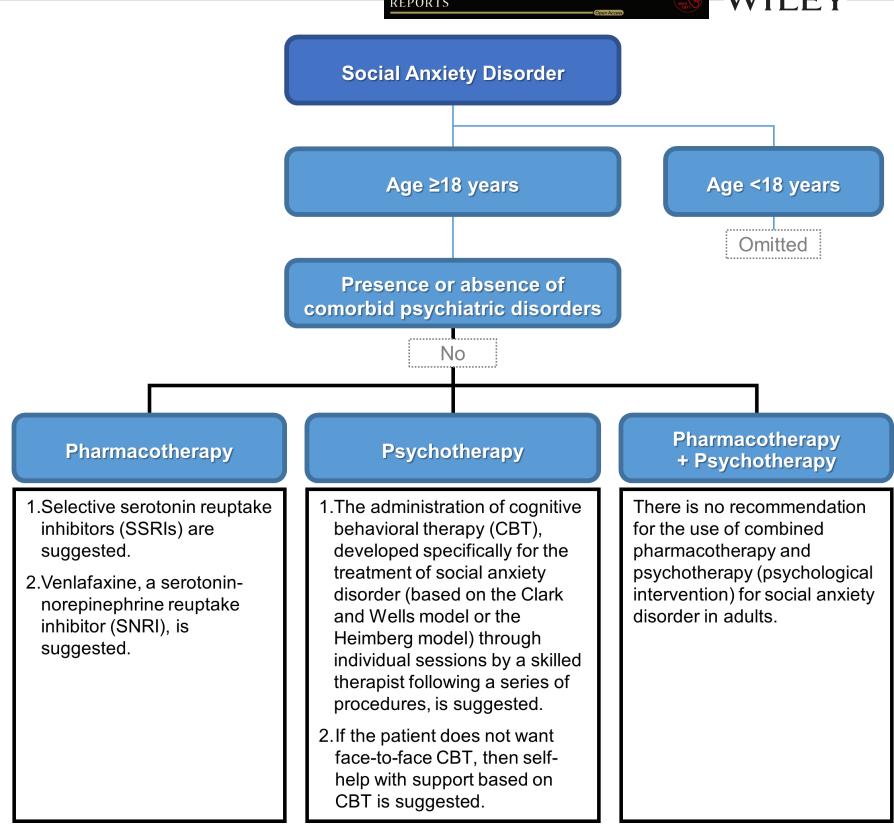
*Figure: A clinical treatment algorithm for adults with Social Anxiety Disorder (SAD) without comorbidities, detailing pharmacotherapy and psychotherapy options*
---
## Pharmacotherapy Options
### First-Line Pharmacotherapy: SSRIs and SNRIs
Selective serotonin reuptake inhibitors (SSRIs) are **first-line agents** — effective, tolerable, and easily accessible [9]. The Japanese Society of Anxiety and Related Disorders/Japanese Society of Neuropsychopharmacology guideline recommends SSRIs and SNRIs as first-line pharmacotherapy for adult SAD [2].
**Medications with proven efficacy in acute treatment** [7]:
- **SSRIs**: Escitalopram, fluoxetine, fluvoxamine, paroxetine, sertraline
- **SNRI**: Venlafaxine
- **MAOIs**: Phenelzine, moclobemide (efficacious but limited by serious adverse effects — hypertensive crisis — and strict dietary restrictions) [9]
- **Benzodiazepines**: Bromazepam, clonazepam (limited by chronic nature of phobic disorders) [7][10]
- **Anticonvulsants**: Gabapentin, pregabalin
- **Atypical antipsychotic**: Olanzapine
**Response timeline**: Response may take up to 8–12 weeks [9]. Response is more likely in patients whose symptoms reduce in intensity within 2 weeks of starting treatment [7].
### Performance-Only Anxiety (Performance-Limited Subtype)
For individuals with **performance anxiety** (fear limited to speaking or performing in public) [2]:
- **Beta-blockers** (e.g., propranolol 20–40 mg orally 1–2 hours before the event) are particularly effective — they block peripheral manifestations of anxiety (perspiration, tachycardia, palpitations, tremor) [9][10]
- **Short- or intermediate-acting benzodiazepines** (alprazolam or lorazepam) can be used as alternatives [9]
- ⚠️ Beta-blockers do **not** help patients with generalized social phobia who fear and avoid multiple social situations [7]
---
## Treatment Selection: CBT vs. Pharmacotherapy
The choice of treatment modality depends on **patient profile and preference** [9]:
| Factor | Favor CBT | Favor Pharmacotherapy |
|--------|-----------|----------------------|
| **Response speed** | Slower onset | Faster response times [9] |
| **Severity** | Motivated patients | Severe SAD — too anxious to engage in therapy [9] |
| **Comorbidity** | — | Comorbid depressive disorder or suicidality concern [9] |
| **Long-term benefit** | Longer-lasting effects [1][9] | — |
| **Tolerability** | Better tolerated [1] | — |
| **Patient preference** | Not open to medication | Prefer medication |
**Combination therapy**: A combination of pharmacotherapy and CBT is often used; however, definitive evidence supporting combination therapy over single-modality treatment is lacking [9]. One study found the combination of phenelzine and group CBT more effective than either alone on response and remission measures, but evidence is inconsistent [7].
---
## Stepped-Care Approach
The RANZCP guidelines recommend a **stepped-care approach** [5]:
1. **Step 1**: Psychoeducation and lifestyle advice (healthy eating, sleep, exercise patterns; limiting caffeine, tobacco, and alcohol)
2. **Step 2**: CBT, pharmacotherapy (SSRIs or SNRIs) augmented with graded exposure, or a combination — depending on symptom severity
**The following flowchart details first-, second-, and third-line treatment options:**
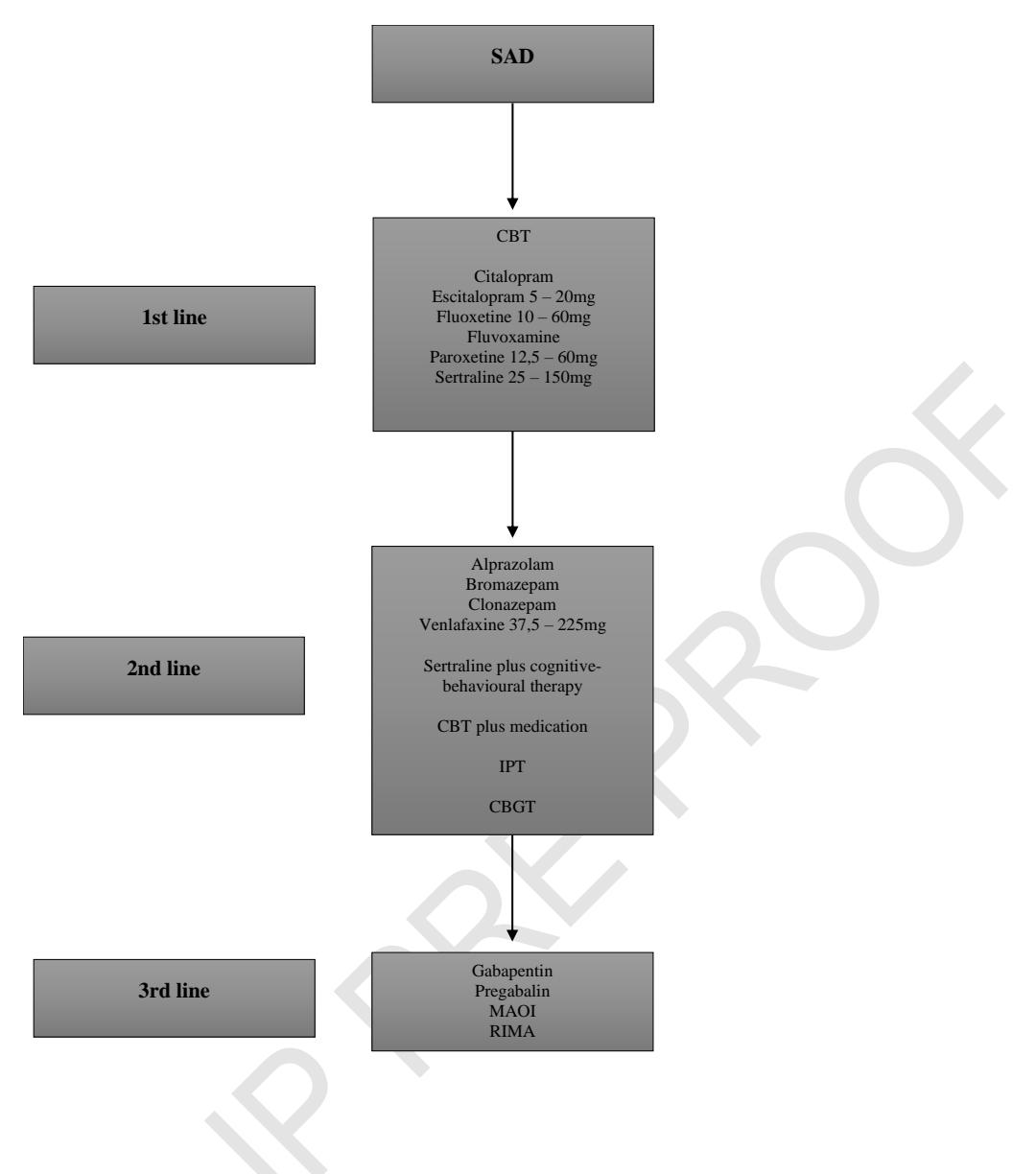
*Figure: A clinical flowchart outlining the first, second, and third-line treatment options for Social Anxiety Disorder (SAD), including both pharmacotherapy and psychotherapy*
---
## Continuation and Relapse Prevention
SAD is typically a long-lasting condition. Successful response to acute treatment should be followed by **at least 6 months of continuation treatment** to consolidate recovery and prevent early relapse [7].
- Relapse prevention studies demonstrating long-term efficacy are limited for escitalopram, paroxetine, sertraline, and pregabalin [7]
- Patients with limited initial response to CBT may benefit from adding medication; those with partial response to pharmacotherapy may benefit from adding CBT [7]
- Combination of sertraline with clonazepam has been found superior to continuing sertraline alone or switching to venlafaxine [7]
---
## Special Considerations
### Comorbid Alcohol/Substance Use
Patients with SAD have a high rate of comorbid alcohol abuse and other psychiatric conditions (e.g., eating disorders), necessitating **parallel management of each disorder** if anxiety reduction is to be achieved [10].
### Children and Adolescents
Fluvoxamine and paroxetine have been used effectively in children and adolescents with SAD. However, **SSRI use in individuals younger than 21 years requires careful monitoring for suicidal ideation and intent** [9].
### Treatment Obstacles
Common barriers to effective treatment include [8]:
- Avoidance of treatment due to fear, shame, or stigma
- Limited screening availability
- Assessment/intervention directed toward somatic complaints rather than the SAD itself
- Clinicians lacking knowledge of effective options or trivializing concerns
---
## Critical Gaps in Current Evidence
- **Optimal treatment modality** (pharmacotherapy vs. psychotherapy vs. combination) has not been definitively established [2]
- **Long-term efficacy data** for pharmacological treatments remain limited [7]
- Most trials have **excluded patients with comorbid major depression or active substance use disorders**, limiting generalizability [6]
- Most studies limited assessments to 8–12 weeks of acute response, with a smaller body of work addressing long-term outcomes [6]
---
## Conclusion
Overcoming social phobia is best achieved through **evidence-based treatment** — CBT as the first-line psychological intervention and SSRIs/SNRIs as first-line pharmacotherapy — with treatment selection guided by patient preference, symptom severity, comorbidity, and motivation. A stepped-care approach beginning with psychoeducation and lifestyle modification, followed by CBT, pharmacotherapy, or their combination, represents the current standard of care.
---
*This content is AI-generated based on retrieved literature and is intended for clinical reference only. Please verify against original sources and apply individual patient judgment in treatment decisions.*